Note: For the purposes of this discussion, argon ion and krypton ion lasers are very similar - they are both rare gas ion lasers, their basic principles of operation are similar, and the same basic hardware configuration and power supplies can usually be used. Differences are primarily in gas fill of the plasma tube and the mirrors/prisms for selecting the output wavelength. Keep this in mind since where we describe something for an argon ion laser, most likely it applies to a krypton ion (or mixed gas 'white light') laser as well. However, this doesn't mean you can just replace one type with another or convert an argon ion laser to krypton by cracking open the seal on its tube and refilling it! For more information, see the section: Comparison of Argon and Krypton Ion Tube Characteristics and the chapter: Ar/Kr Ion Laser Power Supplies.
These are the types of lasers generally used for large scale light shows as well as in some types of high performance phototypesetters or other digital imagers, and for use in holography and other optics research. Unlike diode and HeNe types, a serious interest in these also represents a very serious investment of time, money, and caution.
At least the added plumbing shouldn't be much of a problem unless portability is an important consideration! This is not to say it cannot be done, just that you will have to be pretty determined to get that large laser going in an one-bedroom apartment! In any case, you can't just go and plug one of these beasts into the nearest AC outlet. :)
A small air-cooled ion laser is probably a more reasonable toy especially if you have to share the single 3-prong outlet in your place with the family microwave! :-) And, some of these lasers still have outputs that can approach 500 mW (though most are much lower).
The types of small argon ion (krypton ion types would be rare) lasers that are turning up on the surplus market are often from various high performance scanners, recorders, duplicators (not your ordinary office copier), printers, and phototypesetters.
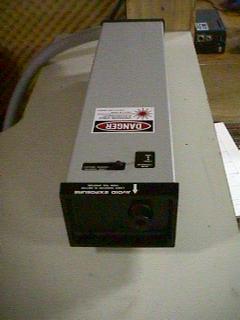
The Xerox 9700 series and older 8700 series (and possibly the 8400 as well) utilized an American Laser Corporation (ALC) 60X argon ion laser. This laser was made to the Xerox "X" standard for a high speed duplicator/printer, hence the X in the part number. The NEC-3030 is also a printer laser and OEM Spectra-Physics (SP) 161 lasers were used in a Times Graphics, Inc. printer. The IBM model 3900, 3835, and 3825 printers (circa 1996) have argon ion lasers and AOMs. Other companies that manufacture or have manufactured equipment containing ion lasers include Dainippon Screens, Hell, and Ricoh.
Many of these older but expensive graphic arts systems are still being maintained and are now being retrofitted with newer technology such as high power IR diode lasers or Diode Pumped Solid State (DPSS) lasers. Therefore, more small air-cooled argon (mostly) ion laser heads and power supplies are showing up on the surplus market at attractive prices. (However, if you would be content with only 532 nm green, there are high quality DPSS lasers showing up surplus from these sources as well. The most common is the Coherent Compass 315M-100 which produces a TEM00 beam with an output power of up to 100 mW. However, red and blue DPSS lasers are still way too expensive for most hobbyists. For more information, see the chapter: Solid State Lasers.)
Some DNA sequencers apparently also contain argon ion and other medium power visible lasers.
For reference, here are the typical wavelengths and expected power output from argon ion laser heads pulled from graphics arts equipment:
Other argon ion lasers that may turn up as pulls from graphic arts equipment include the Uniphase 2202-5BLT, 2202-30BLT, and Spectra-Physics 163, as well as several others.
Note that some lasers that at first appear to have excellent specs may be designed for pulsed (low duty cycle) operation. One example is the HGM Spectrum Compac A Argon Laser. This uses a American Laser 68B tube which would be good for 2.5 W with a proper power supply and adequate cooling but in this case is only designed for relatively low duty cycle pulsed operation. Pulse, cool, pulse, cool, etc. If the price is low enough, it may be worth buying just for the tube (assuming it is still good) but non-trivial modifications will likely be needed for it to run CW.
Additional more detailed information on many of these and other models from ALC, NEC, and SP can be found later in this and subsequent chapters on ion lasers. Also see the section: How to Get a Laser Without Really Trying - Part 2.
However, many older laser printers and related equipment were based on HeNe lasers so don't assume there is an argon ion laser in that dusty thing at the salvage yard (even if quite large) just because it has a laser warning label! (Newer consumer/office type laser printers use relatively low power IR diode lasers.)
Mike Harrison (mike@whitewing.co.uk) has a Web page in the early stages of development which lists graphic arts, industrial, medical, scientific, and other equipment which include internal lasers of all kinds. The page can be updated with your contributions as well. Take the link near the bottom of Mike's Electric Stuff Page (which also has a lot of other interesting topics).
Here are some guidelines for determining if dragging home something bigger than your living room will be worth the trouble:
(From: Lynn Strickland (stricks760@earthlink.net).)
Some of the higher-end stuff from Xerox, ECRM, still have HeNe's in them. The Xerox printers are the kind of machines you'd find at places like Kinko's. (big, expensive ones). Xerox still services some argon ion based units too.
Xerox just yanks the laser heads out after a certain number of operating hours and, last I knew, sells them off on the surplus market. The HeNe's that come out still have quite a few operating hours left in them at that point. For awhile MWK had first dibbs on them, but I don't know what's happening in the last year or two.
(From: Dean Glassburn (Dean@niteliteproducts.com).)
Basically here is the story on Amercian Laser's Lasers. ALC has sold 60X, 68B, 909, and 920 systems in the past. The 60X was used in Xerox graphic arts machines, the 68B, 909, and 920 in medical systems. All these manufactures of the systems that used the tubes have since either gone out of business or found other technology to replace the ion laser systems (e.g., high power diode and DPSS lasers).
About two years ago, ALC's main source of BeO went out of business. Not a major disaster to ALC, because their replacement of those tube types were about 10 a year combined for the 909 and 68B. Ceramic for the 920 was all gone as well as the need for that tube. The current situation is that to get a new tube manufactured there is a 6 to 10 week wait and the cost for the ceramic is twice what it once was, so the tube price new is much higher.
OK that is the current situation. We have sold and rebuilt many ALC systems for use, but the new tube issue always eventually comes up.
The benefits to using these are easy to state: Usually you can find these cheaper than other systems. When working properly, the systems put out good power as designed.
The design limitations are as follows. The 60X was originally designed for 7 to 9 A tube running 488 nm TEM00. This equates to a maximum of 20 mW for 8,000 hours. However, all the 60X systems currently out there are usually old tubes running at a MUCH higher current. To get a higher output of 50 to 100 mw, tube life is very limited. The 909 systems deliver about 5 to 6 watts multimode/multiline. Not the best divergence but not bad either. No fill system on the tube, so life is about 1,000 to 2,500 hours. We have regassed plenty of these and kept them running. As a krypton or mixed gas, life around 600 hours is normal. We usually leave a valve on the tube for regassing. The 68B tubes are usually cracked and cannot be repaired, or run at a low pressure and carbon tracked the bypass. The 920 made a lot of power when running, but it was designed to pump into a Dye laser or a fiber. It is a big bore tube to operate on three-phase 208 VAC at 45 amps, good for about 1,000 hours. You would have better divergence with a flashlight. Changing the optics to reduce the divergence makes a 6 watt, 45 amp laser instead of a 14 watt high divergence laser. Better off with a 909, same output, less power consumed.
However, a word of caution: Just because the connectors look the same or the specs look like the power supply and laser head should be compatible doesn't make it so. Just plugging something together may result in smoke or shortened lifetime. It is a safe bet that if the components actually came from a working system, they will play happily together. On the other hand, if someone just connected a power supply to a laser head that it wasn't designed to drive, tested the combination for a couple of minutes, and sold it as a working system, there could be problems down the road.
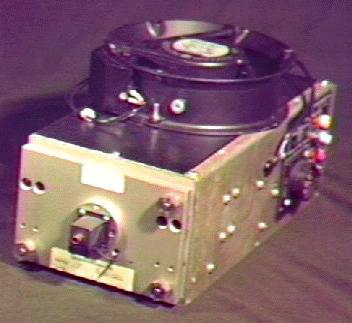
Regardless of whether your laser is built like Frankenstein's monster, it WILL likely be missing the cooling fan and in some cases, even the head cover. The typical Patriot style fans are available surplus typically for between $15 and $30. Other type fans or blowers with similar ratings (220 cfm and up) will also work if the airflow direction is correct (i.e., for the ALC-60X, it must be sucking out of the head). In cases where the fan diameter is much larger than the opening in the head above the tube as with the Patriot and ALC-60X, a 1 inch collar will also be needed between them to act as an adapter plenum. For laser heads like the SP-161 where the cover may be missing, replacements (including the fan) may be available from the original manufacturer or companies like National Laser. though the cost may be a good fraction of what you paid for the entire laser! (In the case of the SP-161, the cover is really only needed for safety - the fan doesn't use the cover for mounting.) But, if you are just a bit handy, they can usually be fabricated relatively easily. Any interlocks that are missing will also need to be replaced. I've even heard of people using vacuum cleaners for cooling ion lasers! (Think of the marketing possibilities!)
Also, don't be upset if the running time meter says something like 64,500 hours! This is typical of a graphic arts pull and doesn't reflect on how much time is on the tube itself - which is the only thing that really matters. You can be sure the tube has been replaced more than once but there is probably no way to actually determine how many hours are on the one that is installed.
Where the umbilical cable has been cut (this happens as well since whoever removed the unit may not have realized that the cable could be extracated non-destructively), a proper connector will need to be reattached. If they are the same type at both ends, the wiring is likely 1:1 so an ohmmeter can be used to determine the connections. However, if they are not the same type (e.g., a Jones type at one end and an AMP type at the other), you will need to find the wiring for each one. Ditto if either end is hard-wired. However, in the worst case, a lot of the wiring at the head-end at least can be determined by tracing connections inside the head. WARNING: A cut umbiliacal could also mean there could be compatibility problems as mentioned above if the head and power supply were not from the same piece of equipment and were never tested together. Even if they use the same AMP connector, there could still be problems. For example, an ALC or Omni power supply may melt down attempting to drive an NEC head or vice-versa without some rewiring and other changes (if it is even possible) even though the connectors mate.
Also see the section: Spectra-Physics-161 Laser - More or Less.
In particular:
See the section: On-Line Introduction to Lasers for the current status and on-line links to these courses, and additional CORD LEOT modules and other courses relevant to the theory, construction, and power supplies for these and other types of lasers.
Several modules would be of particular interest for ion lasers. Unfortunately, the on-line manuals (in PDF format) have disappeared from the MEOS Web site. But I have found and archived most of them:
Surprisingly, there is no module speecifically on ion lasers!
If MEOS should complain, these will have to be removed. So, get them while you can! But I doubt they'll complain. And most are also archived at the Wayback Machine Web Site.
Having said that, argon ion lasers represent the Holy Grail for laser enthusiasts who will likely turn up their collective noses at HeNe lasers once they have become hooked.
I'm sure you've seen the posts on the sci.optics or alt.lasers newsgroups that go something like: "I just got a big laser. What type is it? What can I do with it? Etc." One of these guys is going to look down the bore and get blinded or worse. So I'd also like to see a site up for that reason. Well it turns out there is such a site. There is a excellent laser safety site at: Rockwell Laser Industries.
Note: Since comparisons are made throughout this discussion between argon (and krypton) ion lasers and helium-neon (HeNe) lasers, it is worthwhile to first read the Chapter: Helium-Neon Lasers if you are not familiar with those devices.
The basic design of the argon/krypton laser is conceptually similar to that of the HeNe (or other gas) laser - plasma tube containing the active medium (argon and/or krypton gas) mirrors forming a Fabry-Perot resonator. However, unlike HeNe lasers, the energy level transitions that contribute to laser action come from ions of argon or krypton - atoms that have had 1 or 2 electrons stripped from their outer shells. Spectral lines at wavelengths less than 400 nm come from atoms that have had 2 electrons removed. Longer wavelengths come from singly ionized atoms. There are many possible transitions in the UV, visible, and IR portions of the spectrum. With suitable optics coherent light from a single spectral line or many lines may be produced simultaneously. An adjustable intra-cavity prism can even be included to permit the desired wavelength to be selected via a thumb-screw adjustment.
Beam characteristics in terms of diameter and divergence are similar to those of HeNe lasers. However, the coherence length (without additional optics) tends to be smaller than that of a HeNe laser of similar cavity length. This is because the gain curve for the ion laser transitions is wider than the one for the HeNe laser - around 2.5 GHz compared to 1.5 GHz. So, a larger number of longitudinal modes will be present and the coherence length will therefore be reduced. Coherence lengths quoted by various sources range from 2.5 to 10 cm for typical air-cooled ion lasers.
To excite the ionic transitions and achieve a population inversion, much more current is needed than for a HeNe laser. A 'small' argon laser may use 10 AMPs of current (rather than the 3 to 8 mA typical of a HeNe laser tube). Even at a tube voltage of 100 VDC, this represents about 1000 W of power dissipation. (Think of a typical space heater inside a small box!) High flow rate forced air cooling is absolutely essential - the tube would melt down in short order without it. Larger ion laser tubes may pass more than 100 AMPs of current at up to 400 VDC or more - and require three-phase power and water cooling - figure on utility substation just for your laser!
Thus, while Ar/Kr ion lasers and HeNe lasers are conceptually similar, the approximately 3 orders of magnitude greater tube current and two orders of magnitude greater power dissipation compared to a HeNe laser mean that the construction details are vastly different. You won't find one of these in a laser pointer!
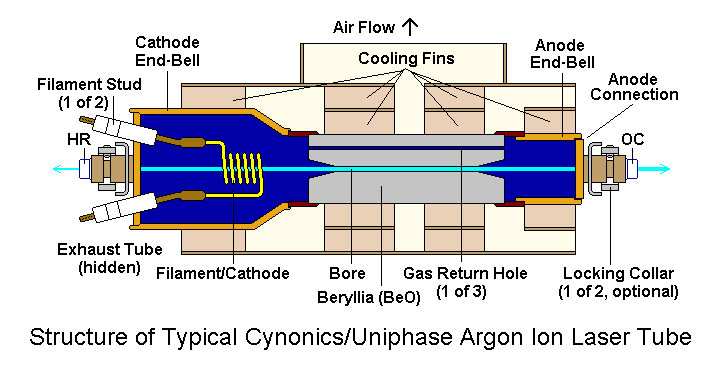
See Typical Cyonics Air-Cooled Argon Ion Laser Tube for the construction of one popular internal mirror type (which bears the most similarity to a HeNe laser tube)! Those from other manufacturers are similar.
The following assumes a small air-cooled Ar/Kr ion tube like that used in the American Laser Corporation 60X/Omnichrome 532 or the Cyonics tube described in the section: Cyonics Argon Ion Tube.
Only a few modern air cooled tubes stand up to 12 A and most models peak out at 10 A, despite what Omnichrome says in their documents. The tubes will invariably come with a 10 A limit sticker. As far as I'm aware, no application ever used the 'special modifications' for 14 A for the Omnichrome 532, these special modifications are going to a tube that is twice as long with 2 huge fans, which is actually the next model up, the 543.
Also see the section: Argon/Krypton Ion Laser Tube Life.
Unlike a HeNe tube, the Ar/Kr ion discharge may not present a large negative resistance once the arc has been struck. Some references suggest that the effective series resistance is on the order of 1 or 2 ohms positive while others indicate that it is a low negative value (or perhaps it depends on the particular tube design and operating conditions). In any case, the tube behaves so much like a dead short that without a regulator or some additional ballast resistance, this argument may be only of academic interest!
If the resistance is positive, tube current can theoretically be controlled by varying the voltage of the supply and a ballast resistor isn't strictly essential as with an HeNe tube just to maintain stability. However, this control would be extremely sensitive to EVERYTHING since a small change in input voltage would result in a large change in current. For example, assuming the effective discharge resistance is 1 ohm for a tube dropping 100 V at 10 A, a 5 percent variation in input voltage would result in more than a 50 percent change in tube current! Furthermore, due to changing conditions as the tube heats, a runaway condition is possible even if the resistance of the discharge is non-negative and must be avoided by using a proper current regulator (or adequate ballast resistance - for testing only).
In any case, if you acquired a head that is missing the HUGE fan - don't be tempted to run it until you have one in place and spinning up a storm (at least not for more than 30 seconds)! Sit a vacuum cleaner on top if you have to but don't skip the cooling!
Large frame Ar/Kr lasers may require 35 A at 400 V running on three-phase 240 VAC, 30 kV or more to start, and gallons-per-minute of tap water cooling!
Think of how much larger the cathode of a HeNe tube is compared to the anode. That much surface area is needed to keep the heating and sputtering at the cathode within acceptable limits. (An HeNe tube WILL lase if hooked up backwards but its life will be significantly shortened.) And that is for a tube using only a few watts compared to a KILOWATT or more for an ion laser.
The typical ion tube has a thick helix of tungsten for its cathode (calling it a 'filament' is really minizing the massive nature of this structure!). The hot cathode results in thermionic emission (the boiling off of electrons from its surface) reducing its work function - the potential (voltage) drop associated with pulling an electron out and away from it to free space. With less voltage drop, less power is dissipated at the cathode itself, there is less damage and less sputtering, as well as a reduced voltage requirement for the power supply. Also see the section: Effects of Improper Filament Temperature.
Also note that the cathode isn't just made out of metallic tungsten - it is specially processed and coated to promote the formation of an sufficiently dense electron cloud so that AMPS of current can be passed through the tube with minimal additional heating at the cathode itself. The AC of the filament supply keeps arc moving in the vicinity of the cathode Even so, if conditions aren't perfect, you can end up with localized heating leading to cathode sag and eventual failure. Repeated attempts at starting, improper gas pressure, contamination, and plasma oscillations can result in erosion of the cathode. An ion tube with a cathode that is not hot enough won't start. One that loses its filament supply during operation will go out - and there may be damage to the cathode in the process.
All in all, what you would gain in not needing a filament transformer, you would lose in having to have a truly HUGE cathode structure to handle the heat dissipation, a much HIGHER voltage power supply, even better then perfect cooling, etc. :-)
This arc temp is well above what would melt glass. There are only 5 or 6 materials that can go into a argon plasma tube and survive the arc: BeO, tungsten, aluminum nitride, pyrolytic graphite and molybdenum. Even the NEC-3030 which has a glass outer bottle, has a BeO tube fused on to handle the plasma and conduct away the heat. If you put enough current through the bore, you get additional wavelengths as the sodium, oxygen. barium, and who knows what else ions start to lase with the argon. Tube materials lasing is not something you want to see despite how pretty it might look. :-) Tubes (and possibly power supplies) don't last long when this happens!
Keep in mind that even the old quartz plasma tubes have beryllium oxide or tungsten bores, and the glass is NOT in contact with the plasma. Beryllium oxide conducts heat 5 times faster then most metals.
You will NOT be able to purchase BeO as it can be an extremely nasty thing if mishandled and you breathe the powder. A small but unknown percentage of people will have their lungs damaged leading to an early death. If somebody gives you a old plasma tube made of BeO or containing BeO components, you should NEVER grind on it, open it, clean it with acid, or breathe the dust it makes when it breaks. When they break, they have to be FLOODED with water, and all the pieces sealed in a plastic bag and sent to a special place for disposal (there should be precisely this warning on the tube somewhere). (And, then you may have to have a Hazmat team come in to clean up your house.) Don't mess with it!
The following were measured with calipers from end-bell to end-bell and then roughly compensated with eyeball for actual bore length:
Given the overall length of these tube, the relatively short bores may seem surprising. The remaining length is taken up with the filament/cathode and support structure, and gas filled spaces of the cathode and anode end-bells. Typical Cyonics Air-Cooled Argon Ion Laser Tube where (although the diagram is not totally to scale) the cathode end-bell is actually longer than the actual bore.
Bore diameters usually range from .55 to .75 mm for small lasers and up to 2 mm for large-frames. Longer tubes require larger bores.
Most of the information below is from the operation manual for a Spectra-Physics large-frame ion laser.
The formula for argon output available from a given ion tube operated below saturation all lines multimode output is:
P = K * (J2) * V
Where:
Notes:
Most lasers in the less then 1 meter class like about 600 Gauss to start. Too much magnetic field in an ALC-60X type tube, can actually kill power, as we have found (--- Steve).
Magnetic fields that envelop the plasma discharge enhances the population inversion, it tends to force free electrons toward the center of the plasma tube bore, increasing the probability of a pumping collision, unfortunately the magnetic field also causes Zeeman splitting of the laser lines, which elliptically polarizes the output, causing partial loss at the polarization sensitive plasma tube windows
The following equation applies to any laser - not just an ion type. Output power can be calculated from:
                                          q * L
                       Po = T * A * I * (------ - 1)
                                          T + B
Where:
The following are some specific numbers for various lasers (from "Laser Fundamentals" by William Silfast, ISBN 0-521-55617-1):
Here are some others you might run across:
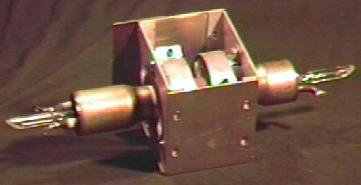
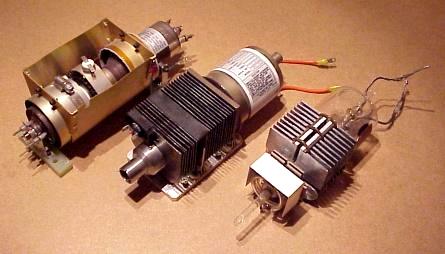
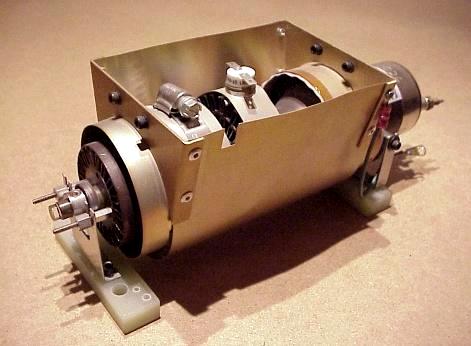
(Photos provided by: Marco Lauschmann (mla@sbk-ks.de). Diagram (don't you just love the fabulous colors? :) from: Sam.)
Cyonics/Uniphase Model 2301 Internal Mirror Ion Tube - Cathode-End showing filament connection studs and mirror mount. Exhaust tube is visible below.
See Typical Cyonics Air-Cooled Argon Ion Laser Tube for some details of its internal construction.
The 2301 is used in the Uniphase model 2011 and older 2201 lasers heads. (There should be a dash number following the 2301 model number: -10 = 10 mW, -20 = 20 mW, etc. The letters following this info determine the wavelength: SL = single blue line (488 mm), GL = single green line (514 nm), VL = 458 nm, BL = all blue (458 nm, 476 nm, 488 nm, and 497 nm), ML = Multiline (all lines).) More complete specifications may be found at JDS Uniphase. Go to "Commercial Lasers", "Argon Gas Lasers".
Typical Spectra-Physics specifications for modern versions of these lasers:
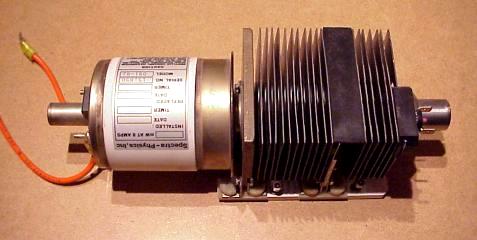
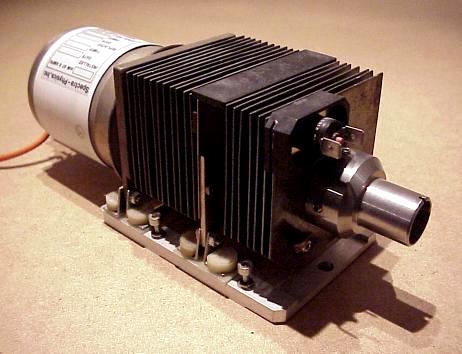
Spectra-Physics Model 091-92 Internal Mirror Ion Tube - Anode-End showing mirror adjustment collar and thermal protector on heat sink.
The basic design is by Dr. Sergei Babin at Novosibersk. They are available commercially as one offs at up to 75 watts. Get yours while they are hot! :)
However, what about a really compact air-cooled argon ion laser only capable of a few mW but made as small as possible?
The problem no matter how you slice it is power dissipation and the bore length required to achieve adequate gain. The smallest commercial argon ion tubes have bore lengths of a little over 75 mm with a diameter of about .5 mm. These may have a lasing threshold as low as 2 A at perhaps 85 V across the tube. Assuming that such a tube could produce 2 mW at a current of 3 A and that amount of power is most that will be needed, the power dissipation of the discharge is reduced to just over 250 W max. For such a tube:
(From: Steve Roberts (osteven@akrobiz.com).)
For CW work, 4 units of 350 cfm Patriot fans for a model 68B, the HGM5 is an ALC-68B with shortened Brewster stems, a bigger gas ballast, and a slightly wider bore, it can be 3 watt CW laser, but is usually ran duty cycled. I have seen ALC-68s do 7 watts on the bench when freshly made. The HGM does run about 500 mW CW and can be pulsed up to 3 watts max for up to say 15 seconds with the existing HGM fan, which is a big squirrel cage type.
The warning label is 5 watts on the HGM5, the medical circuitry clips the power at 3 W.
If you could cool it enough, an ALC-60X size tube can do 2 to 3 watts easily, in fact there is a medical unit that uses a small internal mirror tube at 3 watts using a closed loop water-to-air-cooler in a power-on-demand application at a 5% or so duty cycle. What limits you on an ALC-60X is the glowing red undercooled anode that will open up when you try it - spoken from experience, not conjecture. :-)
Just about every gaseous element has been shown to lase in the IR and some cases visible or UV, but few will lase CW. Xenon is used for resistor trimmers because in its pulsed mode, its green lines are able to be focused tightly, and its per pass gain is much higher then any other gas laser except copper vapor resulting in a compact high power green laser before frequency doubled solid state lasers were available.
The following patents are particularly relevant with respect to small ion lasers:
While patents do not provide all the details needed to construct your own system, they are valuable nonetheless as a starting point for understanding basic principles of operation and system design. Some of the electronics are described in substantial detail.
However, some of these appear to match actual hardware very closely. Of particular interest are the two ALC patents. These outline the principles of operation and provide fairly complete schematics of the power supply for the ALC 60X/Omnichrome 532 laser.
Some information may also be available from the major manufacturers of ion lasers. See the chapter: Laser and Parts Sources for addresses and links.
454.6 nm, 457.9 nm, 465.8 nm, 472.6 nm, 476.5 nm, 488.0 nm, 496.5 nm, 501.7 nm, 514.5 nm, 528.7 nm.
406.7 nm, 413.1 nm, 415.4 nm, 468.0 nm, 476.2 nm, 482.5 nm, 520.8 nm, 530.9 nm, 568.2 nm, 647.1 nm, 676.4 nm.
Which lines actually lase are sensitive to both tube current and gas pressure and thus the color balance (relative intensity of the various wavelengths) will shift as the tube heats up and with age.
To get an idea of the actual perceived color at each wavelength, see the section: Color Versus Wavelength.
Single-line or multiline: This refers to the output spectral lines in the beam. For ion lasers, several wavelengths can be generated simultaneously. The reflectivity curve of the Output Coupler (OC) mirror and tube current determine which subset of the possible lasing lines are active.
Also see the section: Single-Line and Multiline Output.
Single-mode or multimode: This refers to the axial mode structure of the output beam.
The table below shows the distribution of output wavelengths as a function of the type of optics and tube current for an ALC-60X/Omni-532 compatible argon ion tube (specific model unknown).
   Plasma   -------- Laser Output Power (mW) --------
    Tube     Multi- ------ Gaussian TEM00 Mode ------
   Current    mode           ------- Pure Line ------
   (Amps)   -- All Lines --   457 nm  488 nm  514 nm   Lifetime (MTBF) Hours
  ---------------------------------------------------------------------------
      4        20      10       1.0      7.0     0.0      15,000 - 25,000
      6        50      30       2.0     17.6     7.5       8,000 - 15,000
      8       110      70       5.0     27.0    23.0       4,000 -  6,000
     10       220     130      10.0     44.0    42.0       1,500 -  2,000
     12       325     200      15.0     60.0    68.0       1,000 -  1,500
     14       430     280      22.0     81.0    98.0         500 -  1,000
Notes:
A laser set up for multiline operation will usually result in highest total output power but there are many applications where a monochromatic beam is required.
multiline operation requires a set of mirrors with reflectivities designed to achieve laser operation for all the desired spectral lines. Any intracavity prisms are removed.
Single-line operation can be implemented in a couple of different ways:
(From: Steve Roberts (osteven@akrobiz.com).)
The typical ion laser etalon is 15 mm diameter, 12 mm thick, fused silica or quartz, coated to reflect about 10% from both sides, usually with as few coating layers as possible. It's heated 10 to 20 °C above room temperature, stable within 0.001 °C. Without temperature control, it won't be very stable. The laser will flash at 2 to 3 Hz as the etalon temperature stabilizes. You peak it on a bright flash.
Even a thick plate of window glass will get you started, the trick is to position it correctly and keep it warm. Trust me, try making a simple holder using a (Newport) MM1 or MM2 and stick a piece of high quality glass or quartz intracavity.
Etalons need to first be adjusted to what is referred to as "Flash". In other words, extremely parallel to the cavity where minute changes in the angle take the cavity in and out of resonance very quickly. They are then walked to a offset angle that sets the choice of single frequency once they heat up.
I have one of these rugs I maintain running 24/7 locked to an iodine cell with a etalon,
For krypton, the lines are 647 nm and 530 nm. Krypton lines are sensitive to pressure and magnetic field strength. All water-cooled ion lasers have axial electromagnets around the bore to concentrate the arc. A krypton laser will have a high/low field switch as well.
The tables below list the relative strengths of all the important lines for a typical 30 watt argon/7 watt krypton laser with:
Normally, optics are selected to support the mission of the laser - i.e., surgery wants only the blue lines; ophthalmology needs green, red, and yellow; Raman Spectroscopy needs 647 and 676 nm; laser shows use argon for blue, green, and violet, and krypton for red and yellow. Mixed gas lasers use optics selected for 55% red, 20% green, and 25% blue and violet. To kill a line, one of the optics is made more then 15% transmissive at that line.
The 488 and 514.5 nm lines are lower then normal on this list - other manufacturers claim more power for these 2 lines. Note: The total power for all wavelengths adds up to more than 30/7 W because these lines are selected with a prism and are not lasing simultaneously which would result in wavelength competition.
Argon lines:
     Wavelength    Relative Power    Absolute Power
    ------------------------------------------------
      454.6 nm          .03               .8  W
      457.9 nm          .06              1.5  W
      465.8 nm          .03               .8  W
      472.7 nm          .05              1.3  W
      476.5 nm          .12              3.0  W
      488.0 nm          .32              8.0  W
      496.5 nm          .12              3.0  W
      501.7 nm          .07              1.8  W
      514.5 nm          .40             10.0  W
      528.7 nm          .07              1.8  W
Krypton lines (magnetic field optimal for majority of lines, but not all).
     Wavelength    Relative Power    Absolute Power
    ------------------------------------------------
      406.7 nm          .036              .9  W
      413.1 nm          .07              1.8  W
      415.4 nm          .02               .28 W
      468.0 nm          .02               .5  W
      476.2 nm          .016              .4  W
      482.5 nm          .016              .4  W
      520.8 nm          .028              .7  W
      530.9 nm          .06              1.5  W
      568.2 nm          .044             1.1  W
      647.1 nm          .14              3.5  W
      676.4 nm          .048             1.2  W
(From: Skywise.)
Here's what I have. I gathered it from commercial manufacturer brochures and Jeff Hecht's "The Laser Guidebook".
Argon Ion:
   Wavelength (nm)  Rel Pwr
----------------------------
    1090.0
     528.700         0.16
     514.533         1.0
     501.717         0.2
     496.508         0.35
     487.986         0.78
     488.1
     476.488         0.29
     472.689         0.10
     465.795         0.07
     457.936         0.18
     454.504         0.06
     437.073
     363.8
     351.4
     351.1
     334.0
     305.5
     302.4
     300.3
     275.4
Krypton Ion:
 Wavelength (nm)  Rel Pwr
--------------------------
     799.300
     752.5
     687.096
     676.457       0.22
     657.000
     647.100       1.0
     631.2         0.03
     593.3         0.03
     575.3         0.03
     568.192       0.31
     530.868       0.33
     520.832       0.16
     484.666
     482.518       0.11
     476.571
     476.244       0.12
     468.045       0.14
     461.917
     457.720
     415.4         0.08
     413.1         0.53
     406.7         0.30
     356.4
     350.7         0.32
     337.4
Depending on gas fill, current, optics, and luck, there may be other weak lines present including: 437 nm (argon), and 457.7 nm, 461.9 nm, 657.0 nm, 687.0 nm, and 799.3 nm (krypton).
As a side note, the color saturation with an ion laser is unbelievable, it's possible to get 16.8 million distinct shades with off the shelf hardware. I know the eye can't resolve that but the results you can see are beautiful.
(From: Tom Yu (tlyu@mit.edu).)
I found the following interesting comments on relative power of the various argon ion lines in my Spectra-Physics 164/166/167/168 manual. (These are the medium-frame 1 meter water-cooled Argon or Krypton lasers that want 3-phase 208 VAC at 40 A per line or so.)
"A more interesting effect in the case of argon, specifically, is that of relative intensity and gain ratios in the case of the two strong lines, 488.0 nm and 514.5 nm. Most of the visible laser transitions in the CW argon-ion laser have approximately the same gain-to-power ratio as 488.0 nm, although they are weaker than that line and generally have less gain. The 514.5 nm line, however, has only about 1/4 the gain of the 488.0 nm line, but has approximately 25% more power output when the gain is sufficient to overcome internal losses. This effect is largely due to the difference in the atomic constants that determine the power-to-gain ratio, owing to the fact that the 514.5 nm upper state comes from a different family of levels than do most of the other transitions."
It seems that this explains nicely why the 514.5 nm line is quite weak at lower powers but quickly becomes as strong as the 488.0 nm line at higher tube currents.
(From: Steve Roberts.)
Here are some additional lasing lines from Alan B. Peterson, In "New Developments and Applications in Gas Lasers" Lee R. Carlson, chair/editor SPIE Volume 737, based on the proceedings of a 1987 conference on gas lasers, pp. 106-111.
Nobel gas ion lines not previuosly reported (nm):
 Argon: 307.816, 276.223, 437.594

 Krypton: 379.270, 330.473, 322.062, 317.22, 304.692, 302.230

 Neon:  372.710, 372.684

 Xenon: 377.629, 376.897, 376.226, 373.022, 367.662, 366.675, 365.461, 364.831,
        312.569, 310.863, 304.425, 297.051, 295.478, 282.251, 281.968, 276.778
The book has lasing conditions and power but no details about transmission on the optics. A magnetic field up to 1,600 gauss was used, as most of these are III transitions. The experiments used a type SP-171 and a type SP-2020 tube. The author is/was an employee of Spectra-Physics.
The most common white light lasers are large frame ion types with a mixture of argon and krypton for the gas fill.
White light lasers are now even available in air cooled format. All use a mix of argon and krypton. Many are made for a roughly 60:20:20 ratio of red, green, and blue lines for proper white balance. Their reliability is increasing with cost staying a little above normal Ion laser prices. Spectra-Physics, Coherent and Lexel all manufacture tubes for this. And LaserPhysics, Inc. sells the air-cooled version that runs off single phase 220 VAC and does 400+ milliwatts. Most of these lasers are modified for reduced operator skills with sealed mirrors and simplified power supplies. So, yes, they are out there, and laser company reps tell me the demand is going up as people start to use them for lab and industrial applications as well as display.
There are other ion lasers that aren't optimized for best laser show or TV color rendition but for other applications. For example, some biological mixed gas and biological krypton will kill green, lase red, yellow, and blue, With RYB optics, there will never be more than say 4 lines and no green, not 514 nm, not 520 nm, nor 530 nm. The RYB optic will have a 15% or greater transmission from 500 to around 550 nm. The lasing transmissions are about 1.5% for blue, 0.8% for yellow, and 1.2% for red. If it has RYGB optics, there will be about 7 lines. Note that for the laser enthusiast, these have a high novelty value but are less than ideal for for display due to their wavelengths as noted above. With external mirror lasers, the optics sets can be replaced but this may not be ideal if the gas fill ratio and pressure isn't optimal.
CREOL in Florida and quite a few other labs have demonstrated RGB as well in diode pumped frequency doubled YAG lasers so smaller and more practical is just around the corner as soon as ways are found around the materials and quality control problems with solid state laser components. Right now they have to test 4 or 5 crystals for every good one they get.
Note that other technologies can be used for white light lasers. For example:
(From: Colin Evans (c.j.evans@goose.ac.uk).)
A white light laser was developed in this department several years ago. It was based on a helium-cadmium mixture which could lase simultaneously at red, green and blue wavelengths. There was no automatic balance between the three colours and had to be carefully adjusted using the pressure and temperature. Also, I don't know whether the three colours could be regarded as "coherent" in any sense. Advantages are very strict polarization, and narrow parallel beams, neither of which are much use in a projector.
(From: Marco Lauschmann (mq-laser@gmx.de).
The only real white laser I know of used a Bucky-ball (carbon) compound which was optical pumped by the 488 nm line of a argon ion Laser. The emission was a real white light continuum - not like the 488 nm, 514, nm and 647 nm lines of an Ar/Kr ion laser system which looks like white light to the human eye. Researchers at the University of Manchester Institute of Science and Technology have demonstrated that confined buckyballs emit strong white light when excited by blue light from an argon-ion laser. Although work is at an early stage, the group has already identified some possible applications for this new material. They suggest that it may form the basis of a new laser material or new types of optical displays.
Another source for a white light continuum is a Ti:Sapphire regenerative amplifier with a frequency doubler. So, a white light continuum could be produced with 800 nm output of 150 Fs, 500 uJ pulses at 1 kHz from a Ti:Sapphire regenerative amplifier, which extends from 400 to 1500 nm. A 5 cm long piece of fused silica is the non-linear element and was used to generate the continuum. This is only an example - there are systems which deliver a white light spectrum with average power of more than 1 W with repetition rates of 250 kHz or more.
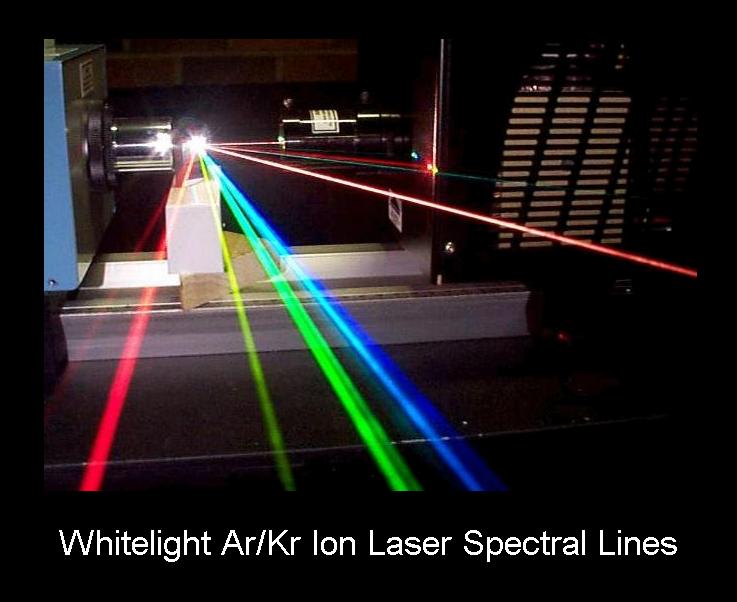
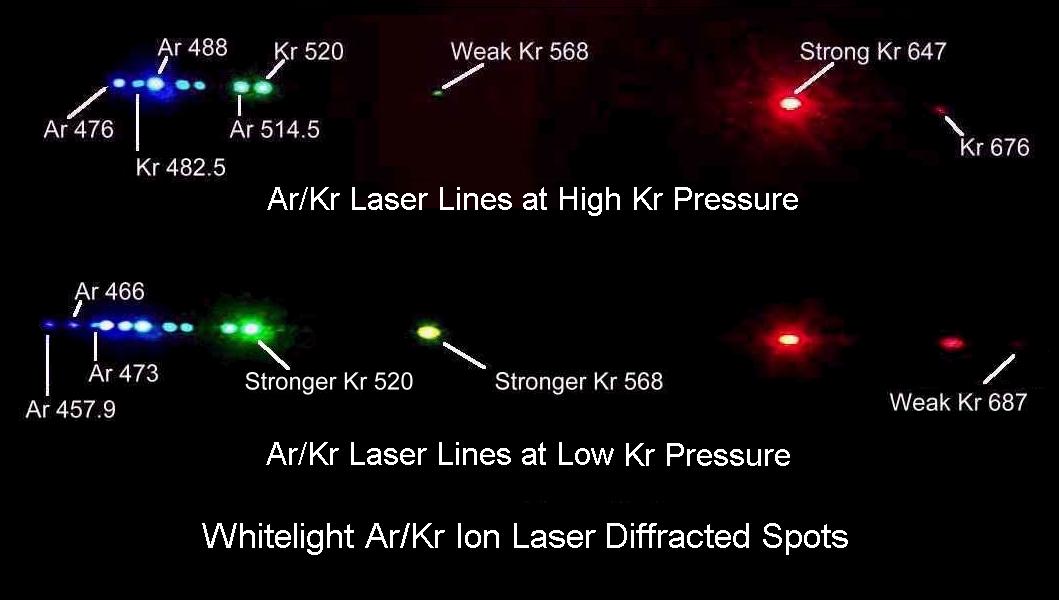
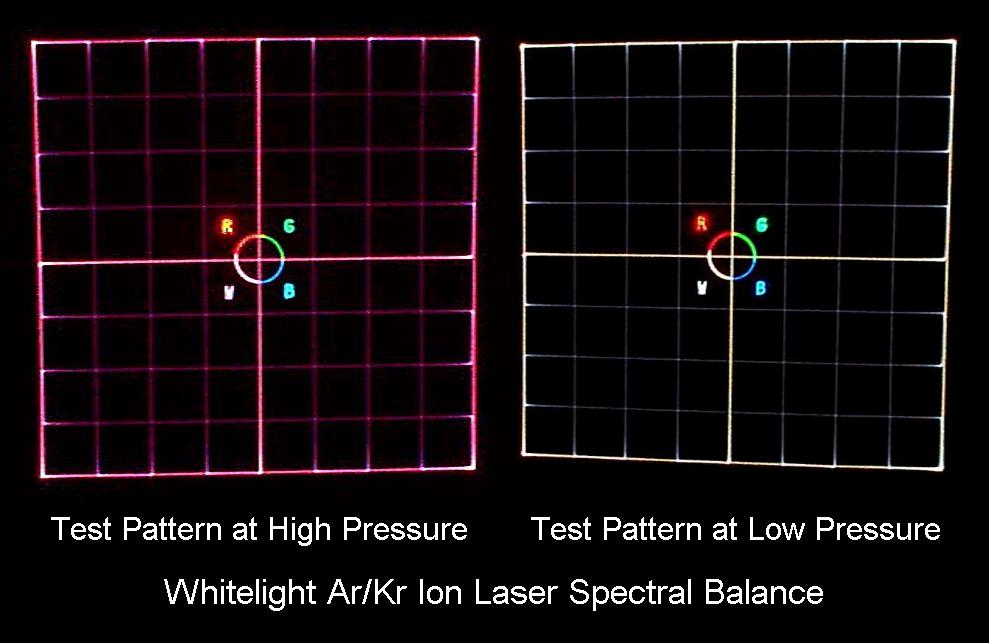
A word of caution. The digital camera does not record with the same range of brightness the eye can perceive visually. Thus the intensities of the laser lines are somewhat "compressed".
Please note that the 530 nm Kr green line is suppressed on YBR Krypton and White Light lasers as it suppresses gain on the 568 nm yellow line. That's why the normally very strong green line at 530 nm is also missing in the spectrum and pictures. Killing the 530 nm line also kills the 528 nm line in argon because the coating is not that selective. This is in addition to the red/yellow pressure branch problem. This laser was shipped initially very high in pressure - these pictures are the result of what happens when the excess gas is "burned off" after many hundreds of hours of operation. What is missing is the picture of the initial state of this laser, which had just the 488 and 482 nm lines lasing with the red lines, which results in a sort of strange magenta color.
(From: Steve Roberts (osteven@akrobiz.com).)
Argon ion lasers are generally shipped with broadband optics installed, they are usually a 100 to 200 layer dielectric stack. The high reflectors are coated for 99.999% reflection at all wavelengths (that the laser may be set up produce - they will still be transparent at others). The OC is what is changed. Wavelength selective output couplers are coated for a minimum 15 to 20% transmission on lines that are *not* supposed to lase, and the transmission for desired lines varies from .5 to to 12 %, depending on the length of the laser. Higher power tubes have more gain and thus use a higher transmission. An air-cooled laser will have transmission in the .5 to 1.5% range, short-frame water-cooled lasers will be in the 2 to 5% range and 25 watt large-frame types will be in the 8 to 12% range. It is possible to adjust the coatings for a given color balance if you have a large number of identical tubes. Ion optics are sold as matched pairs, and loosing half a pair can ensure that you will play musical mirrors and maybe not even lase. However some manufacturers have different OCs you can use with a given HR.
In the case of lasers with a intracavity prism, unless the client pays extra for special optics for a weak line that doesn't have that much gain, a broadband set is still used.
White Light lasers using Ar/Kr mixes are using a mirror coated for 400 to 700 nm broadband high reflectance and an OC that usually kills the 531 nm line of krypton, as these compete with the yellow line for gain, thus killing the yellow if they are allowed to lase. The 647 nm red and 568 nm yellow lines share the same upper state and thus the optics must be tailored for a given red/yellow balance on a given laser tube design at a given gas pressure, thus making these optics even more expensive.
A typical 1/2" diameter large-frame optic is $400 to 500 from the factory PER optic. White Light optics are about $2,000 a set minimum.
Still it's a selected silica filled epoxy with a high Tg. low cost 5 minute epoxy from the drug store or department store wont do it.
If you dare, take a very sharp razor blade and very slowly press its sharp edge in against a unglued older brewster where it joins to the stem and POP! Off comes the now ruined window and a flat undamaged polished face is usually left on the stem. If you stick that window between polarizers in a stress analyzer, it is now very deformed.
(From: Steve Roberts (osteven@akrobiz.com).)
This depends on the line and size of the tube. In a long bore laser, there may be a 10 to 15% gain on some lines while on other lines there will be little or no net gain. Some lines share a given upper state and tube conditions such as pressure and magnetic field determine where they fall. For example, the red and yellow lines of krypton will fight each other. If I recall my Spectra-Physics manual correctly, there are two weak argon lines that can also fight, but I can't remember which ones and it's an insignificant difference in normal operation anyhow.
For a short tube argon, there may be few percent increase in power with single line optics. They are used for spectral purity in a short tube ion laser. For example, each line comes to focus at a slightly different point on the film or drum in a printer or copier which means you would have to filter out one of the lines or use expensive achromatic optics. Or, a particular line is used for spectroscopy and the other one would increase the noise level if not removed.
Narrow band dielectric mirrors are easier to manufacture anyhow so they should be cheaper as well - a win-win situation for many applications.
There are several parameters which must be closely matched to achieve enough resonator gain and make alignment something that doesn't share too many characteristics with Chinese Water Torture. :)
The best option if you really want to do this (realizing that a partial mirror alignment will almost certainly be needed in any case), is to acquire a replacement OC or complete mirror sets designed for your particular model laser. Some companies sell what they claim are 'high output optics' at similarly high prices for this purpose. Unfortunately, I don't know of any reliable way of determining whether a given product will do anything for you or your laser other than waste an afternoon or more in installation and alignment. Specifications are rarely detailed enough to make a decision on technical merit. So, if you are willing to spend the time, at least get a binding money back warranty.
However, where you have something sitting on the shelf or a potentially good deal arises, here are some considerations:
For example, here is a table of OC traansmission percent (100 minus reflectivity) for some typical argon ion lasers:
          Output Power   OC Transmission   Circulating Power
         ----------------------------------------------------
               .1 W            1 %               10.0 W
               .5 W            2 %               25.0 W
              1.5 W            3 %               45.5 W
              4.0 W            5 %               80.0 W
             10.0 W            8 %              125.0 W
             20.0 W           11 %              182.0 W
The "Circulating Power" is the light flux inside the cavity. While not
really useful (it can't be tapped off for anything practical), these high
values do demonstrate that there is serious activity going on in there (and
the Brewster windows must be able to handle it)!
"I have a XYZ corporation small or medium-frame ion laser. It's old, but it seems to have gas. I didn't get optics with it. I don't even know if it's argon or krypton. Heck, it may be mixed gas. What optics should I buy?"
(From: Steve Roberts (osteven@akrobiz.com).)
Recent experience suggests that just about any 1 meter class ion laser will lase with the following mirror specs, at moderate power with no major sensitivity to alignment. You may or may not get peak possible power, but IT WILL lase, over a wide range of pressures, gas mixes, and magnetic fields. Mode quality is not guaranteed, and we observed everything from TEM00 to doughnut mode to high order multimode. However none of the odd modes such as 1,2 or 2,2 or 3 to 5 were seen and in each case, a round beam was obtained. When doughnut mode was lasing, the band to hole ratio was at least 20 to 1, i.e., a very small hole.
These combinations has been tested on a Lexel 88, Lexel 95, American Laser 68, HGM 5, HGM 20, Spectra-Physics 164/168, and Omni 543. In krypton, argon, and mixed gas. In every case, it lased well but not always on every line.
The HR had a 2 meter radius with 100% reflectivity at desired wavelengths.
The OC had a 2 meter radius with transmission as follows:
There is a second yellow line in Kr. It is never spec'd in manufacturers' data because it is hard to obtain without a prism and special optics. There is also no major demand for it, and its gain is much lower then the 568 nm yellow. But we had it lasing day before yesterday. One tube rebuilder specs his White Light optics for this line and kills 568 nm to obtain a stable yellow for planetarium displays.
530 nm green was killed at the HR during some tests by use of a standard argon or KR OC. In one case, a standard argon HR produced lasing on 2 blues and two yellows in pure krypton. In no case was the 528 nm argon line observed as far as we know, it seems to require a low transmission. (But see the section: How to Get 528 nm in an Argon Ion Laser.) Lasers tested were a mix of Kr only, Ar only and MG lasers. The optic used for the OC was 7.62 mm in diameter. This optic was good for some lasers, but resulted in extra high intracavity powers for others. In some cases performance was better then factory optics. A few larger lasers were tested with a 1 meter mirror at each end and this worked well, but 1 meter mirrors were not recommended for the ALC-68/LExel-88/Omni-543 sized lasers as power was weak due to lack of mode volume.
Argon optics pairs produced poor low power lasing on pure krypton as their transmission was too high, i.e., the Lexel-95 standard argon optics were very poor and resulted in only a faint blue from the same sized krypton.
Thanks to Dale Harder, and Bruce Rodgers, and Dr. S. for access to their lasers. Thanks to Karl at Promethius Photonics for providing the high grade chemicals used in this study.
I wanted 528 nm from an argon ion laser. I'd only seen it once in a huge Laser Ionics tube at very high pressure. Strangely, that tube had a more or less orange glow at the cathode sheath, much more orange then normal. Now I know why. After a year of research and wondering if my prism was walking out of alignment when cranked to the 528 nm position, I found the solution in a old gas laser text the library was throwing out. It turns out you need a trace of neon in the tube to get the right upper state. No wonder 528 is always labeled "special testing required" from the manufacturer.
About that 300 mW claim, all I can say is: Ha Ha Ha Ha Ha Ha Ha....
150 mW yes, 175 yes, 225 to 250, yes on a factory select tube. 300, hum... Rarely and not for long unless it was designed that way. Note where the PSU current limit is set when they claim this. Note that newer high-tech tubes can do this running on 115 VAC. One manufacturer does make a 300 mW sealed mirror retrofit for the 60X. Laser Physics' Reliant series certainly does.
What happened is when large quantities of these units were in use, a few companies made money rebuilding them in quantity. They bought large quantities of pulls for rebuilding. They didn't care which tube they installed in a unit, as long as it met spec and lasted out the warranty. So therefore once in a while you can hit the jackpot on a used laser and get a hot tube. Once in a while you can also pick up a head that was designed for high power.
It's with special multimode optics and a high divergence doughnut mode or worse beam shape on a selected tube. Notice how vendors have power graded pricing, this lines up with the factory catalog of tubes. Note that lasers almost always are shipped doing well above the factory rating when new. Yes this gets you 275 mW or so on a fresh new high power tube at 10 A with brand new optics and a sweet new cathode. To sustain it for any length of time it takes 11 A. But I'd want a iron clad warranty I could enforce.
The idea is buy a hot laser and run it lower then its rated power, and thus enjoy longer life. Thats why you could retune that tube to 110 mW or so, it was derated for longer service and the optics were tuned to run at a fairly constant power over its life. Run it at 60 to 70 mW and enjoy it for a long time.
And, as with any laser, the CDRH safety sticker or catalog listing may not be an accurate indication of useful or possible output power. Actual performance may be a small fraction of what you expected! This is a significant issue with ion lasers since they have many variables affecting output power (compared to internal mirror HeNe lasers, for example, where the output power is pretty much fixed - it isn't affected in a significant way by tube current or often not even much by age and use). The output power of an ion laser is a strong function of tube current and life expectancy is inversely proportional to tube current! So, the rating on the CDRH safety sticker is likely to be much much higher than what could be used with expectations of a reasonable tube life. And, unscrupulous or unknowledgeable people can list the power based on a ridiculously high tube current where life might only be a few hours! Ion tubes that are physically the same size and interchangeable in a laser chassis also can vary by a large factor in power ratings even if they are new depending on manufacturer and model. For tubes with external mirrors, the type of resonator (single-line fixed, single-line with line selecting prism, multiline) as well as alignment and cleanliness, strongly influence output power. At least you can remedy problems with some of these with some basic maintenance or parts replacement. However, age, total operating hours, and possible prior abuse, are also significant factors affecting ion laser performance and there is little you can do to revive a weak tube.
Also see the sections: Locating Laser Specifications and Buyer Beware for Laser Purchases.
(From: Dean Glassburn (Dean@niteliteproducts.com).)
Most of these lasers came from xerox machines which were set up for single line 488 nm TEM00 running at about 6 to 7 amps when installed. New they would do about 15 to 20 mW in that configuration. There were also slightly different tubes (bore diameter) which would preclude higher current densities as the cross sectional area of the active region was smaller. You can and many do install broadband mirrors which would more than double the output. And, you can increase the current as much as 100% (double) as installed, which would give you the higher power limits advertized (and, of course, much shorter tube life). Additionally if the optics were not carefully aligned it was real easy to catch the rubber between the photocell and the front tilt plate when beam walking the laser which would smoke the rubber onto the front optic and beam splitter.
A used laser is just that - and priced accordingly unless the tube meets specifications as originally installed. And some units due to the smaller bore diameter will never attain the higher power levels.
(From: Mike Kenney (MKenny1989@aol.com).)
Nearly all of the 60Xs made for Xerox came with 200 cm, 488 to 505 nm TEM00 optics - very flat and wern't coated for all of the argon wavelengths. That's why if you had a new tube from American Laser with Xerox optics you might get 85 mW at 10 amps. However, with 60 cm, 450 to 530 nm multimode optics, you can get 250 mW at 10 amp. I just sold one with a new tube (not regassed or refurbished) that was putting out 200 mW at 9 amps. The true capability of these lasers is only really understood by American, Omnichrome, and National laser service and that's about it.
(From: Steve Roberts (osteven@akrobiz.com).)
I'd tend to agree, although the hottest 60X I've ever seen on a laser power meter was 225 mW. However when you figure out the uncertainty in the power meter calibration, that tends to jive. Xerox needed a small focal point and the AO used on the sled would tend to diffract out the 514 and 477 nm lines a lot, so the narrow band was needed to get a tight spot. Xerox Sled AOs are carefully AR coated and have a wedge on the backside of the crystal that probably corrects for the diffraction.
My source for used optics was a rebuilder who had Xerox contracts, he bought heads where ever he could get them, and stashed all the old optics in 55 gallon drums. He gave me a couple of hand fulls of optics from each drum and put them in optics shipping boxes from Coherent Auburn division. I'd get a laser off a used xerox sled and reoptic it using something from the barrel batch, or some bought from a laser engineer living in SLC., usually just the OC, and WHAM! 110 to 150 mW and all lines on many of the units. It would take some matching of the optics to get the best power. Tubes with better heatsinks also did better, so I suspect heat transfer plays a part.
I also agree that the factory can dial in the lifetime and power to anywhere they want it. There also were other tubes that I knew were brand new but I could never coax more then 20 mW out of them as well.
The middle of the road optics that I prefer all had 120 cm radius, its a nice tradeoff between beam diameter and divergence compared to the 60-60s, and some customers would gladly sacrifice some power for a tight beam. The hottest 60X I ever saw was a dual side fan 60C that had a TEM01 structure and all lines and was from a HELL Typesetter, it would easy burn holes in the wall. I didn't have a PM with me, but that laser would give my Lexel 88 a run for the money.
The really good high power "X" OCs have a deep cherry red color when viewed in transmission, as opposed to the straw or yellow color of the tailored copier optics. But you can't just go by the color, for example I've seen I've seen optics from Auburn that have a radial gradient, or "bullseye" pattern that performed just as well as the cherries and were almost transparent. Usually just the OC is doctored, its kind of expensive to change anything but the radius on both optics, and that coating is really dialed in. We have a excellent UV/VIS spectrometer here at work and I can barely make out the changes in transmission from a known high power all lines optic except they bleed out much more 514/528 nm green and have reflectivity almost to the UV. The difference is a fraction of a percent in transmission. I can also easily see the 10% or more changes in transmission on a line that is killed.
However the thing I always wanted to read was the document that spec'd the OC transmissions versus wavelengths for all the different factory shipping powers, it would be very interesting. I did once find the curves for the RYB krypton lasers developed for confocal microscopy, and the changes needed for a given power were very minute.
However, it should be possible to estimate the power output of a small ion laser using a simple laser power meter such as the one described in the sections: Sam's Super Cheap and Dirty Laser Power Meter or Simple Laser Power Meter Using Photocell. In fact, about all you really need is almost any type of photodiode (those from old computer mice floppy drives are fine), a working 9 V battery (even if it is tired and puts out only 7 V), a multimeter that measures DC mA, and a 1K ohm resistor (to protect your multimeter should the photodiode be connected backwards or decide to turn into a blob of solder). :)
The approach below makes use of the relative brightness sensitivity of the human eye to provide a reference in comparison to a HeNe laser at 632.8 nm with a known power output. The simple laser power meter can then be used as a relative indicator of ion laser's output at various tube currents. To perform the comparison, the ion laser must have adjustable output (from just above threshold) and the actual power output of the HeNe laser must be known - not just the typically much higher value printed on the CDRH safety sticker.
This same basic approach (with minor modifications) can be used for other types of lasers with variable power output or through the use of a variable laser attenuator or set of neutral density filters.
For a single-line ion laser, use that wavelength. For argon or krypton ion lasers with multiline (all lines) optics, use 488 nm and 647.1 nm respectively, since those wavelengths will be dominant at low power. Multiply the (actual) HeNe power, P(HeNe), by the ratio of the eye's relative sensitivities at 632.8 nm and 488 nm.
So, for a single-line 488 nm or multiline argon ion laser, the output power, P(488)0, will be:
                                      .171
             P0 = P(488)0 = P(HeNe) * ----- = P(HeNe) * .895
                                      .191
It may be possible to do this without any instruments by comparing the power determined by comparison with the HeNe laser to values in the chart shown in the section: Argon/Krypton Ion Laser Tube Life. However, depending on your actual current threshold, it is possible for the relative power versus current relationship to be quite different for your tube and optics.
The output couplers on argon lasers are 5 to 7% transmissive, (much greater than the helium-neon output side mirror). (Note: These values are on the high side for short tubes at least compared to the table out of the service manual for a commercial argon ion laser in the section: Substituting Optics Between Lasers. --- Sam) So an argon has more gain and it scales as a semi-log function of current density. The upper limit is the tube material melting - about 100 watts output at present in experimental (very large) tubes. (A HeNe tube peaks in output power and then declines as current is increased.)
However, for a typical small air-cooled argon ion laser, 100 mW beam power out for 1,000 W electrical power in is only about .01 percent efficient which is not quite as 'efficient' as a HeNe laser (e.g., 6 mA at 2,450 V for a typical 10 mW HeNe laser - about .07 percent).
For a mid-size water-cooled argon ion laser - say 4 W out 7,000 W in, the efficiency is somewhat better - about .057 percent. :)
Some specific numbers for maximum output using multiline optics from a few common argon ion lasers:
                           -------- Tube Input -------   Output
           Laser Model     Current   Voltage   Wattage   Wattage  Efficiency
      -----------------------------------------------------------------------
       Cyonics-2301-20ML     7 A      100 V     .7 kW      .02 W   .0029 %
       Omni-532             10 A      105 V    1.05 kW     .13 W   .0124 %
       Lexel-88             20 A      165 V    3.3 kW     1.5 W    .0454 %
       Coherent-CR18SG      50 A      550 V   27.5 kW    18.0 W    .0654 %
Power outputs (and efficiency) for krypton ion lasers is must lower - perhaps
1/10th to 1/5th of the numbers listed above at the same power input.
So, from this very comprehensive listing, the larger the laser, the more efficient it is likely to be when operated at full power. Note that this doesn't take into consideration the losses in the power supply - figure another 10 to 30 percent reduction in efficiency for that!
The Omni-532 is for all practical purposes a exact drop-in replacement for a ALC-60X. Or, that could be reworded that an ALC-60X is a exact drop-in replacement for an Omni-532. Both lasers were made to the Xerox "X" open standard. While there are minor differences in the electronics, there are major differences in the construction. For example, Omni-532 heads have a cast aluminum alloy L shaped resonator while ALC-60Xs have the traditional rod and end-plate resonators floating on a baseplate.) There are also proprietary differences in the ion tube construction, but their I-V curves are very interchangeable.
Other air-cooled argon/krypton ion lasers are similar but not identical. Keep this in mind where specific component values or designs are described - variations are likely where a different laser is concerned.
An air-cooled tube is a neat little thing about four times the diameter of an average glass HeNe tube. Most have external mirrors and Brewster windows, but many are of the sealed mirror variety. What they all have in common is a heated cathode (like a vacuum tube such as a magnetron) requiring 3.2 volts at 10 to 25 amps. They operate from a range of 4 to 10 AMPs through the arc (Yes, that is AMPs) at around 100 VDC. The tube current is fed to the cathode via a center tap on the filament winding of the transformer to balance the arc on the center of the cathode to avoid plasma etching of the cathode supports. Hence the need for a beefy transformer with #14 or #10 wire on the secondary. Rewound microwave oven transformers work well for this purpose.
The tube is designed for a 100 to 105 V voltage drop, and is ran directly off the rectified and filtered AC line. This makes regulating the tube current a very interesting problem in design because we also have a series injection igniter (similar in function to a HeNe starter) which is a 3" toroid with 80 turns on the secondary and one turn on the primary. A 10 uF cap is charged to 110 or 400 V depending one the model of laser and is dumped directly into the 1 turn primary through an SCR which has a reverse connected fast switching (10 ns) diode across it. You end up with a 500 Khz 30 kV ringing wave pulse applied to the tube, which can blow the arc out as well as ignite it. The winding on the igniter transformer is also #14 wire as it also carries the entire tube current. There is no ballast resistor (as would be found in a HeNe laser power supply) as it would have to dissipate up to 1,000 watts at times. There is a .2 ohm resistor in the anode lead inside the head to sense the current for feedback to the supply, and a beam-splitter sampler that drives a solar cell for the fine loop, which keeps the light level constant to .05% and is used to cancel out noise and oscillations in the beam.
An air cooled tube's current may be regulated in a variety of ways including a series pass-bank of 4 high power NPN power transistors in linear mode, with two 700 V, 20 A PNP transistors ahead of them in switch mode; two 400 V, 25 amp FETs are used in a buck mode converter at 80 Khz; or just a linear regulator. Larger water cooled lasers which run off three-phase and need 20 to 35 amps of tube current use about 100 large NPNs in series/parallel strings for fine adjust and SCR's on the incoming phases for course adjustment.
The fun part starts when you buy the laser, the power supplies are scarce and run about $900 to $1,250 used. When the laser tubes are pulled for a rebuild every 5,000 hours the PSU stays in the photocopier/printer/medical instrument/typesetter or whatever until the whole unit is discarded. So the laser heads show up, but supplies keep their initial value.
A tube is good for 2 to 3 rebuilds, and after 5,000 hours they usually have 1,000 to 2,000 or more hours left for they hobbyist to enjoy. Most of the lasers are built as 150 milliwatt units and ran at 20 milliwatts to enhance lifetime, so even an old laser still has a lot of potential.
There is no book on how to maintain these things either and since it is the Holy Grail of laser hobbyists to own one, maybe it's time they learned how to maintain them, clean the optics, align the mirrors, peak the performance and find out how to avoid paying $3,800 for a used one when you can get one for less then $1.000. I (Steve Roberts) paid $125 for my head, and built my own power supply.
Also see the section: Maintenance, Alignment, and Modifications of the ALC-60X Laser Head for much more detailed information on the ALC-60X/Omni-532 laser.
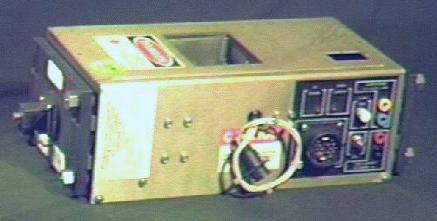
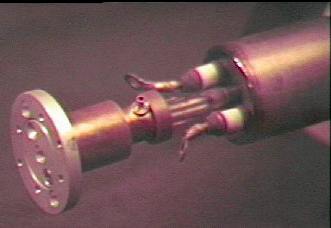
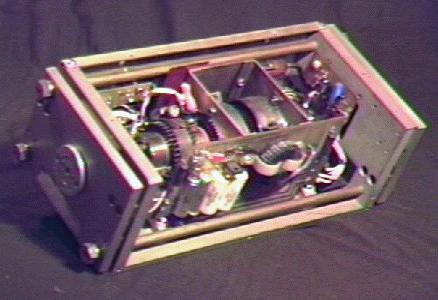
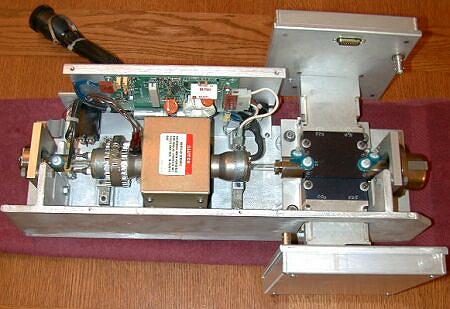
(The following photos are from Steve Roberts (osteven@akrobiz.com) and Jeff Keyzer (jkeyzer@ucsd.edu).)
The beam exits from the copper tube attached to the square box - which contains a beamsplitter mirror which directs a small amount of light to a solar cell optical power sensor.
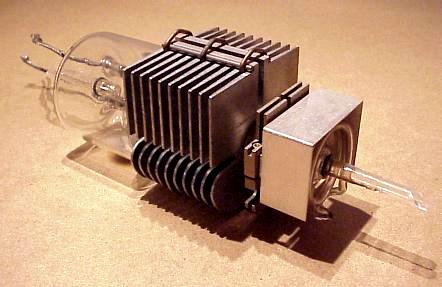
If your laser has had its tube replaced at some point (which is very likely), its appearance may differ considerably from the photo (different style heat sink fins, etc.). Some older versions apparently also include a pair of auxiliary electrodes (one at each end of the tube) poking into the Brewster stems outside the bore via glass-metal seals. See the section: About Those Extra Electrodes on Some ALC-60X Tubes.
CAUTION: These are very fragile where the glass to metal seal joins them to the tube body. Try not to put pressure on them. Running the laser at full current with a finger print on the window can damage the quartz face. Do not make the mistake of trying to remove the window to clean it, it will let air into the tube. :-(
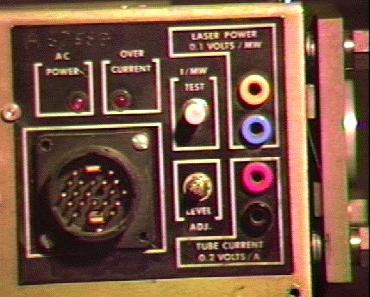
WARNING: NEVER measure tube voltage on the tube-side of the transformer. You WILL destroy your multimeter if the starter is working!
CAUTION: The black and red jacks are across a resistor in series with the tube and are at 60 to 100 VDC referenced to the case. You will read a voltage from 0 to 3 VDC on the meter, at .2 V/A.
WARNING: Cross connecting the red and black current jacks to the blue and yellow light jacks can blow up the laser system. Even through a voltmeter, the button is there to remind you and protect you. Like they said in Ghostbusters, don't cross the streams!!! For power supplies on lasers over 20 milliwatts, the light jack is not an accurate measure of power, it is there for you to keep track of performance and for tuning the cavity (for best results use a analog meter while tuning).
Additional photos of the ALC-60X useful in conjunction with maintenance and alignment procedures can be found starting in the section: Maintenance, Alignment, and Modifications of \ the ALC-60X Laser Head.
Also see the Laser Equipment Gallery for for many more detailed views of ALC laser heads and power supplies.
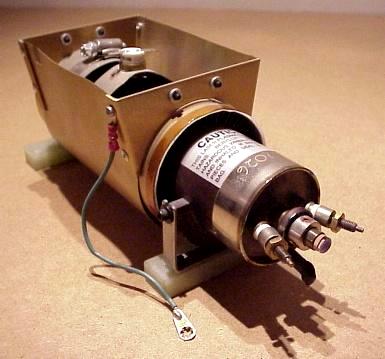
The ALC-60X laser head is a box about 13-1/8" (L) x 6-1/8" (W) x 4-1/2" (H) made of goldish colored (alodyned) aluminum with thick ends plates - actually not part of the box structure but rather the movable parts of the mirror mounts.
The primary structure is composed of three, 3/8" InVar rods placed near 3 of the 4 edges of the box. They are bolted to the fixed portion of the mirror mounts at each end. The rods extend through these plates and another pair of thick plates - the moving part of the mirror mounts. They terminate in the large hex (you have to use a wrench) mirror adjustment screws.
I mounted the fan on a 1 inch standoff made from a strip of 1/16" aluminum, about 20 inches in length, formed into a roughly 6 inch ring (with a couple of flats to accommodate the actual shape of the Patriot fan). A slightly used bicycle inner tube was slipped over the ring prior to its ends being joined which acts as a gasket and protects the 60X's "high quality finish". :) This avoided the need to buy an 8 foot length of 6" PVC (as recommended at the above site) for just a 1" long piece. Can you believe my junk box didn't have one of those!? Two 8-32 holes were threaded into the 60X cover into which 2" long screws were installed from below to act as mounting studs.
For the complete schematic of the ALC laser head, see the section: Omnichrome 150R Power Supply and 532 Laser Head (Omni-150R/532). The Omni-532 is identical electrically to the ALC-60X in all major respects.
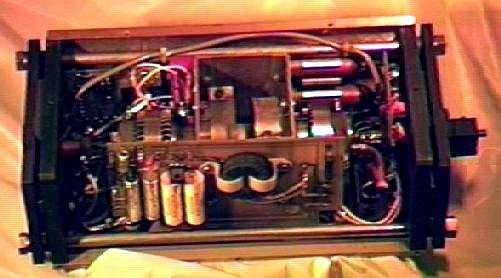
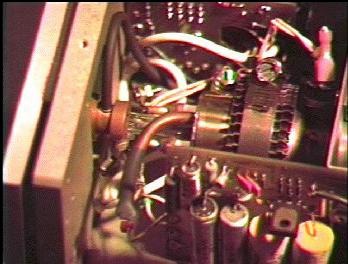
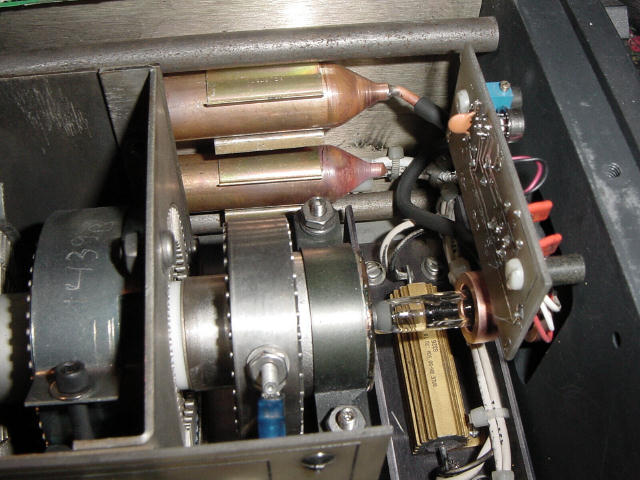
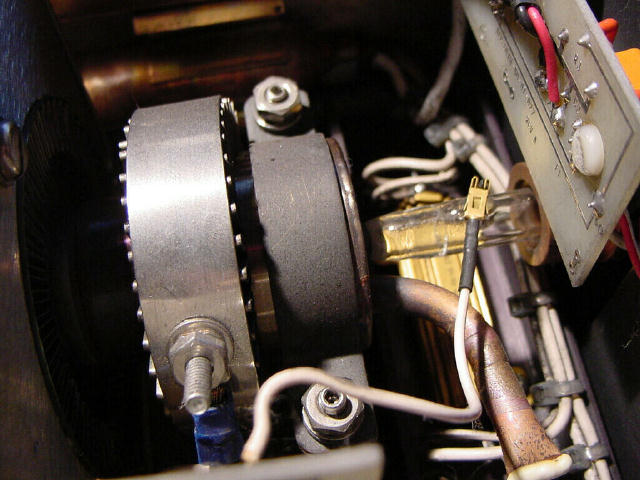
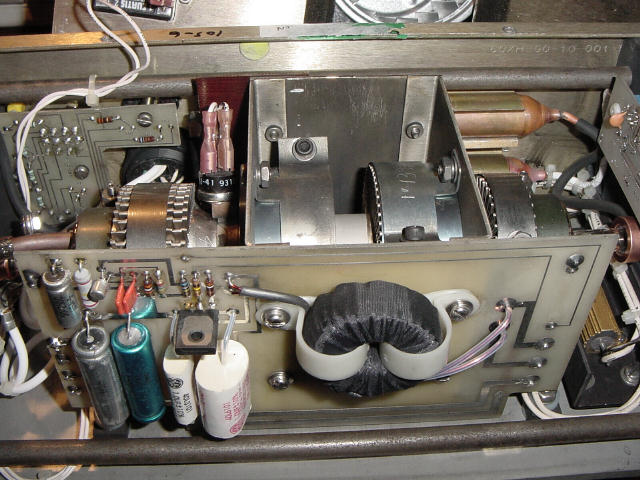
The interior is dominated by the 60X ion tube, its riser box with the main core heat sinks (2) and the anode and cathode heat sinks (the latter with its thermal protector). The tube is mounted on four 6-32 studs that are insulated from the chassis and provide height adjustment to center it with respect to the optics at either end.
A pair of dessicant flasks are mounted on the wall on the panel-side of the box. These are connected by rubber tubes to the mirror mounts (or should be). They are filled with a silica gel dessicant to absorb moisture and thus keep the optics in a dry environment. They also allow the air inside the optics assemblies to expand as the temperature changes but remain isolated from the dirty outside air (like all that messy toner). If your 60X arrived with the rubber tubes disconnected or missing, the silica gel likely needs to be revived (heated in an oven to drive out the moisture) or replaced, and the optics will probably benefit from a good cleaning.
The ignite card is mounted on the opposite wall and contains everything except the large blocking diode which is mounted separately on its own heat sink.
The light sense preamp card is mounted at the output-end of the box.
All the wiring in the ALC-60X is the same boring white (at least after you get all the toner off of it!) and bundled together so tracing anything is virtually impossible. You have to use the schematic and an ohmmeter!
Answer: It is possible but you would only get 15 to 20 mW of red or 7 mW of yellow but not both at the same time. (Maybe slightly more, see the section: Comparison of Argon and Krypton Ion Tube Characteristics.)
Answer: No. Water cooling it will not increase available power as you are limited by the cathode and what the PSU can source off of the 115 VAC line not to mention needing 2 or three isolated cooling loops.
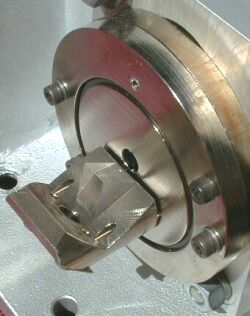
On the opposite end of the output aperture, there may be something that looks like an angled mirror or prism covered with a metal cap. This is called an intracavity prism and is used to select which line lases. It operates by deflecting each of the lines by a slightly different amount - as any ordinary self-respecting prism would to create a spectrum. :-) Only photons of the selected wavelength make it through the prism-mirror combination in such a way that they bounce back down the bore of the cavity and contribute to the lasing process. (The intracavity prism can be replaced with a broadband mirror for all the lines to lase.) Turning the vertical adjust nut/screw/knob on the rear mirror will select the line. Set the current at around 8 to 9 A when you adjust it. Beware of touching adjustments on the prism itself.
A common type is called a "Brewster prism". An example is shown in Wavelength Tuning Assembly using Brewster Prism. This shows such an optic mounted between the Brewster stem of a 60X type tube and the HR mirror. A precision screw (not visible in the photo) allows the angle of the prism to be adjusted to select wavelengths.
One elegant way of implementing the prism-mirror combination is with a single element called a Littrow prism. The Littrow prism is shaped in such a way that light entering its front surface at its Brewster angle is refracted by the precise amount needed such that it reflects back along the identical path from the prism's rear surface. If this is broadband HR coated for the wavelength range of interest, there will be essentially no losses when oriented correctly within the cavity of a polarized laser (e.g., using a tube with Brewster windows). However, the angle of refraction does change very slightly with wavelength so that the Littrow prism can be used for line selection by adjusting its precise orientation with a micrometer knob.
Also see the section: Typical Behavior of Wavelength Tuning Assembly.
      Spectral       Plasma Tube Current         Thumb-Screw Rotation
        Line        6 A      8 A     10 A      Clockwise from 514 nm Line
   -----------------------------------------------------------------------
        514 nm     6.8 mW  24.0 mW  48.0 mW                0 Turn
        501 nm     0.0 mW   1.2 mW   5.0 mW              1/4 Turn
        496 nm      .9 mW   4.5 mW  10.8 mW              3/8 Turn
        488 nm    17.6 mW  37.0 mW  60.0 mW              1/2 Turn
        476 nm     2.4 mW   7.3 mW  14.3 mW              3/4 Turn
        472 nm     1.0 mW   3.5 mW   7.5 mW              7/8 Turn
        465 nm     1.5 mW   2.3 mW  11.5 mW            1     Turn
        457 nm     1.3 mW   4.6 mW  10.0 mW            1-1/4 Turn
        454 nm     0.1 mW   1.1 mW   2.5 mW            1-1/4 Turn
I've seen tubes down to 99 V (at around 10A) and still working, but the usual range is 101 to 115 V for a X tube, with 101 V being dying and 115 V being overfilled. This depends on many factors including tube bore (not all tubes you may find in a 60X head have the same size bore) and fill pressure. It's a rough guide used by techs working on a system to judge performance and remaining life, usually done by comparing the voltage at a reference current while watching a power meter, and then checking against the factory test sheet for that given tube. You really need a reference to go by, it is not an absolute method unless you have a pile of tubes for comparison tests or the factory sheet for a given model and submodel. That is why nothing more specific can really be given here.
These are called "catenodes" and are there to aid in keeping residual dust inside off the Brewster windows. They were included before the source of carbon dust in these tubes was eliminated. The catenodes work by neutralizing the charge on any particle before it could hit the window using a soft glow discharge from the wire to the inside of the tube. The plasma greatly accelerates any dust in the tube toward the most neutral place - the Brewster windows, which are the last places you want it! They were no longer required once better processing techniques allowed by hard-sealed windows became available. A few older SP medium and large frame ion lasers also used to have them.
The catenodes do not particularly aid in starting and the tube will run just fine without them. However. the boost voltage on the start card is the only voltage high enough in the PSU to fight the tube and cathode drop. They only need a few hundred microamps to function so the connections are via 88K resistors. All 60X start cards have the pads for the resistors, even after they stopped making tubes with the catenodes.
A fresh 60X argon ion tube should drop about 106 to 109 Volts at 10 amps doing 95 to 107 mW, all lines, with TEM00 optics. This would typically mean a 60 or 200 cm radius output coupler (OC) and a flat high reflector (HR). It outputs about 200 mW with a 60 cm radius OC and a 60 cm radius HR. Of course the diameter and divergence suffer!
Larger bore 60X tubes designed for argon can be converted to krypton. However pure krypton is usually not an option for most 60X tubes as the bore and gas return are much smaller then required. Although adding 30 to 40% argon will help with the problem of the igniter pulse blowing the krypton out, stability is hard to achieve. Adding a ballast tank with a large flow path to the cathode-end can cure some of the problems by surrounding the cathode with gas when the krypton is sucked down the bore by cataphoresis. Gas velocities in an ion tube can reach 30 cm/second in larger tubes and the argon and krypton have a tendency to separate to different ends of the tube making the discharge unstable. Krypton really needs larger gas returns and some form of ballast. In modern water cooled lasers, ballasting is handled by the spaces between the bore disks and the large cathode bell.
Due to Paschen's law, in some cases the krypton gas will find a low current, low amperage discharge down a long return path to be more sustainable then a direct path down the short bore. One company compensates for this by adding a card to their mixed gas power supplies with a comparator. If the supply senses a ignited return path the current will be much lower then the normal idle and the supply will then start pulsing the igniter till the tube lights down the bore.
When filled with krypton, the same tube with a 45 cm radius OC and a 45 cm radius HR outputs 647 nm and 676 nm red at about 35 mW while dropping ONLY 85 volts at 10 A. These were the only optics we could find, and were less then optimal.
Krypton runs at a lower voltage, but unlike argon which is a semi-log curve in output versus current, krypton has a knee curve for gain. There is a certain threshold above which all hell breaks loose. I doubt we were at that threshold and we didn't have time to experiment with the pressure of the fill. Below the curve you get mostly 676 nm. A 60X emitting a cherry red beam is a rare sight indeed and we did it just to see if it could be done as many people told us it could not be! We even took it to a conference to ensure witnesses!
More recently, Steve did the following:
An air-cooled 60X filled with krypton will tend to lase on just the 482 nm blue line at lower pressure then transition over to some 568 nm with less blue, then finally the 647 and 676 nm lines will lase with yellow being long gone. This is if you can get it to ignite stably in pure Kr and add a big ballast. There actually can be a crossover region between yellow and red with NO lasing of either!
Note that Gold box power supplies are highly stressed to nearly explosive running a 85 volt tube at 10 or 11 amps. Note also that a Kr+ tube needs to be driven much harder for a given power level, so the 11 amps at a lower tube voltage is approaching the more normal conditions of 1,600 watts in argon operation, but is still hard on the PSU and is vulnerable to acoustic plasma oscillations inside the tube. Acoustic in this case means 20 to 60 kHz and these oscillations can rip apart a PSU. I have already distroyed one PSU testing this, but switching to the destruction proof resistor PSUs decreases your chances of a long tube life during initial processing by ignoring oscillations you may not see in the beam. A hybrid of resistor and linear is required, as well as a variable energy igniter, as its easy to blow out a krypton arc with a hot ignite pulse. While a different igniter helps, having more voltage across the unlit tube boosts chances of a cathode spot forming and the discharge starting. A "simmer" power supply similar to those used in arc lamps may also be a aid in starting.
You also need white light or red optics with a 0.5% or less transmission in the red and need the multimode 60/60cm RoC configuration to achieve any decent level of power. We're talking about maybe 30 mW here unless you have a real large bore high power tube or a factory krypton tube and the tube redone was a working argon doing 110 mW or more with a fresh cathode. It will be hard to achieve white balance, with pure Kr you generally end up with one of the following three combinations: "bright yellow, dim blue", "dim red, dim yellow, and dim blue at very low powers", or "brighter red and bright blue" at higher pressures. Adding argon gets you RGB and higher overall power up to a point at the cost of total loss of yellow. Argon raises the tube voltage, making it more acceptable to the PSU, but red starts falling as the pressure rises and the percentage of Kr decreases in the tube. It's a tricky balancing act. The 488 nm line of argon will tend to dominate if argon is added, with the 482 nm Kr blue falling off due to its higher ionization voltage.
(From: LaserguruChris (laserguruchris@aol.com).)
Krypton gas gets "burned" off a lot faster then argon requiring a much bigger gas ballast so they physically will not fit inside a 60X laser head. Power output is really low as well at this size, no more then about say 20 or so mW at balls to the walls current at a wavelength that is laser pointer red at 647 nm. This is not cost effective compared with say diode lasers or helium neon lasers.
Nevertheless one such laser does exist, and while not pure krypton it does contain it. This tube is designed to lase on lines of both krypton and argon. While basically similar to a typical air-cooled argon ion laser tube, it has a large external gas ballast tank and would not fit inside a 60X head. It is used in a strange medical device called cytomeric analyzer (sort of a cross between a laser particle counter, an absorption spectrophotometer, and a high presure liquid chromatograph). These machines used to use a HeNe laser for counting and a filtered broadband light source to do the detecting. The multiple wavelengths of the white light laser make this machine work much faster as the sorting and counting can be done at the same time.
The Omni-543 comes in variants from 300 mW to 800 mW. The PSU is very similar to an Omni-150, but may have 4 MOSFETs in series-parallel instead of the normal 2 in series. The filter caps will be in series instead of parallel and the filament transformer will be a 220 VAC model.
There is a long glass tube in the laser head which is a gas ballast. Take extreme care as that ballast tank is exceedingly fragile!!! Don't even set it down on a table hard! Maybe 1/2 G of force max! The short rubber tubes are the connectors to the dessicant flasks for the B-windows and mirrors. Otherwise the thing is basically an Omni-532 with twice the arc length and different bore diameter. As expected, it needs about twice the cooling as the Omni-532.
The tube voltage is high enough that it probably only will run 220.
The Omni-160 power supply is basically similar to the Omni-150 but with additions specifically for the higher tube voltage and possibly for use with White Light (Ar/Kr) ion laser heads:
(From: Steve Roberts (osteven@akrobiz.com).)
The four big issues are:
Minor issues:
As for small 488 only tubes designed for tem00, the bore is WAY too small to support multimode multigas operation, the bore diameter is designed to limit the mode and prevent you from upgrading a 10 mW tube to a 300 mW tube. usually small tubes have a minimal amount of ceramic in them, and couldn't take the additional heat stress from full current operation. Cost is important for small argons, and lots of steps are taken to get that cost down, most of which really limit bore energy.
You're better off using a nice 80 mW 658 nm diode and an air-cooled all lines argon ion laser. Since a good power supply design can drive an argon ion laser head to do 200 to 300 mW off of 115 VAC these days, diving down to ~70 mW of whitelight power is a drag. Whitelight tubes do not excite argon directly, a charge transfer effect from the much heavier Kr atoms pumps the AR, so you can loose a lot of 514 nm and a big amount of visual punch.
Exception: Certain tubes do well in a green killed low power red yellow blue mode, using mostly krypton, at a 5-5-5 mW or 15-15-15 mW power level. It's visually a blue white in appearance, but not too useful outside of instrumentation/scientific applications.
I have tested a 643-RYB-A01 which is an Ar/Kr ion laser which produces red (647 nm), yellow (568 nm), and blue (several lines including 488 nm). Green is suppressed by the mirror coatings for its intended application, possibly because green would overwealm the expected fluorescence signatures being detected. It reaches rated power (47 mW total) at 6.4 A but will produce over 135 mW at 9.4 A (according to the test sheet that came with it).
However, a funny thing happens at about 8.6 A (assuming the test point calibration is correct): The color balance suddenly changes to less yellow and more blue and/or red AND the current drops to about 6 or 7 A. It has been suggested that this is hitting the gas return limit whereby the argon and krypton circulate at different rates and thus the gas fill mix in the bore changes. It's necessary to drop the current back down to near idle at which point the color balance changes back, equally suddenly. So, I'm not sure how it was tested at 9.4 A or whether perhaps it needs to be run for awhile to correct the gas pressure, having not been used for at least several months.
In fact, I measured approximately 150 mW total at just under the transition current, maybe 8.4 A. So, too bad about the gas return limit. Otherwise, it could go much higher!
(From: Steve Roberts (osteven@akrobiz.com).)
White Omni-643s have the same basic tube bore diameter as the higher powered argon version. Converting an argon ion 643 to white-light is possible. Max power would be about 60 to 70 mW assuming the tube has a good cathode. The mix would be almost all krypton, much more then a few percent argon, and it fails to start easily. Whenever we try to up the argon ratio for more green power, we can't start the thing, and you need a 220 VAC supply or a boost transformer. Others who have white-lighted these have made the same comment, getting a gas mix that will stay lit and deliver green power is tedious.
However, I wouldn't white-light it, I'd yellow/red it. They scream with a RYB optic and you can get mondo yellow. that yellow is a gorgeous golden yellow, and if you have a little blue coming out you get a beam that appears bluish white. Add the red, dial out some blue and a it's a color you'd never see on a TV or monitor phosphor or any other light source, a very radiant saturated "Sunkist" orange. If you ever get, say a Lexel-95 krypton, put in a RYB OC optic from an air-cooled laser, and a broad-band HR, and you get the same orange, but much more of it. Most laser techs like the 647-488 or 633-488 mix, known in the laser show biz as "Atomic Flamingo Magenta", but I like the 647-482-568 (or 575) Orange!
If you use the standard Omni optics you get a really intense yellow line, a nice 647 nm red line, 488 nm argon and 482 nm krypton blues, some krypton greens, and the 676 nm Kr line. A buddy of mine has one on station right now and is experimenting with different mixes. Strangely, 514 nm argon green hasn't shown up in our tests.
However, it's a crap-shoot on rebuilding small tubes. If your tube is factory and still has a positive or neutral delta-T it is probably a candidate for repump with a 60/40 chance of some success, if it's been run with a negative Delta-T, it probably would need a new cathode installed. This assumes the Brewsters are squeaky clean on the inside. Aim a bright HeNe laser beam down the recently cleaned Brewster. If there is much scatter from the inside face, then forget it. Argon with the much higher gain doesn't get attenuated as bad from the inside scatter.
The real determination of how well krypton will work in a given tube is very dependent on the gas returns as well as bore size. Higher power argon tubes will go krypton, as their returns have higher capacities. Tubes that were designed for 5 to 30 mW of argon with a small bore to limit power just wont go red, we can get stable plasmas, but not in the lasing region.
So, I set up an adjustable mirror mount just in front of the output aperture of the laser and installed the broadband OC from a large-frame argon ion laser. Its reflectivity was about 99% from 470 to 520 nm, RoC unknown. Since there is always output from the normal pair of mirrors in the laser, it is trivial to align the additional mirror. There are multiple spots from the multiple reflections between the auxiliary mirror and original OC. When all these spots merge into one, the mirror is perfectly aligned, about 30 seconds on a bad day. Near that point, a nice strong green output appeared in addition to the original red, yellow, and blue. However, the green was excessively powerful, cutting the intensity of the yellow line significantly. The reflectivity of the new mirrors was too high at the green wavelength.
So, I replaced the first mirror with one having a reflectivity of around 96.5% from 470 to 520 nm and an RoC of 2 meters. That restored most of the yellow with some reduction in the green. Only one green line, probably at 530 nm, was present. But there was an additional blue line not prevsiously present at idle current. A mirror coated for somewhere between 90 and 95% at 530 nm (narrow band) would probably be ideal to produce a balanced RYGB laser but I had exhausted my inventory of suitable mirrors. :)
In both cases, the output was quite stable with none of the unpredictable behavior associated with trying similar stunts with lower gain HeNe lasers. The color balance remained about the same (visually) as the current was increased from 4 A to 8 A.
CAUTION: With the high photon flux between the OC mirror and auxiliary mirror, the monitor photodiode is totally saturated so that light feedback always operates at the lowest (idle) power setting regardless of knob position. Therefore, only current mode could be used to increase the output power. The photodiode was undamaged but I'm not sure that can be guaranteed at higher power in current mode and/or with a higher reflectivity auxiliary mirror.
Some companies offer permanent magnet kits for use on specific models of air-cooled ion lasers. Do these work or are they in the same class as magnetic water treatment? What if anything can you expect from a $50 to $200 investment? Is there an alternative using materials found around the house?
The first problem is that there really isn't any good place to put magnets in most air-cooled ion laser heads. With the massive heat sink/cooling fins surrounding the tube, the magnets can't be placed close to the bore where they will do the most good. Therefore, they must be much more powerful than the type used with water-cooled tubes. There really isn't much space to put a large solenoid in a 60X type laser head which limits you to a series of permanent magnets with the same pole facing inward toward the axis of the bore. They would have to be very powerful magnets being so much further away from outside the head sinks. Getting any sort of uniformity out of such an arrangement would be tough.
With some tube/head designs like those used by SP and NEC, this might just be impossible with their square/rectangular heat sinks. For the ALC-60X and Cyonics tubes with cylindrical heat sinks, there may be space - barely. But, being unable to implement a continuous, uniform, axial magnetic field, don't expect anything dramatic.
In the end, even the advertising for these add-ons only claim a 20 percent improvement at most. As noted below, actual performance may be much less than this. And, the power may even decrease. The only way to confirm any change would be with a laser power meter - your Mark-I eyeballs and mushware based CPU won't be able to reliably compare beam brightness before and after the magnet installation.
If you have some high strength disk drive positioner rare earth magnets - the kind requiring a small crowbar to get apart, some spare time on your hands, a laser power meter, and are willing to risk your laser head should something go wrong like a magnet working loose at the wrong time, you can try some experiments. Several identical (same strength) magnets will need to be arranged equally spaced around the tube - preferably at multiple locations. They must NOT interfere with airflow and be placed such that their fields are not short circuited by ferrous parts close to the tube. They must also be securely mounted. All must have the same poles (N or S) facing toward the bore.
In the end, increasing the tube current by .5 A will probably be a more reliable way of boosting power output by an equal amount (of course, there will be some decrease in tube life, but you can't have everything!).
(From: Steve Roberts (osteven@akrobiz.com).)
One, you need a high temp magnet, most wont hack the repeated thermal cycles. If they heat up above their Curie point, any magnetism is history. One company had been offering an add-on electromagnet. Radio Shack magnets need not apply for this position - they will heat up, drop off and block airflow. (They are also quite weak in comparison to what may be needed - Sam.)
Two, you need a fresh tube, with lots of green, as the green lines appear to be the field sensitive ones. The gain using a non-focused magnet structure (which is what you're likely to get) is a pittance of that obtained with a proper electromagnet around the bore. It's also strongly current dependent, and doesn't work at low currents or on tubes at low pressure. Don't bother unless your laser is already doing at least 80 mW. That's from multiple tests on multiple tubes.
Three, only certain 60Xs work with this, the ones with soft iron rings around the cooling fins, inside the riser box. Because thats where the magnets go. They get stuck on the rings, like poles facing inward (usually 3 magnets per ring or 6 magnets per ring) to form a soft theta pinch on the plasma. One magnet having more or less strength then any of the others can mess you up. We're talking magnets you can barely separate by hand.
Some stats:
                ---- Output -----  --- Net Gain ----
                 Before   After     Power   Percent   Cost
                -------------------------------------------
                  62 mW    67 mW     5 mW     8.1 %    NA
                  80 mW    87 mW     7 mW     8.8 %   $50
                 117 mW   135 mW    18 mW    15.4 %   $70
However, on many tubes, no net gain was observed, and never on any tube below
45 mW. The largest gain was still much less than 20 percent even on the
'hottest' tube. (Where cost is given, it is for an array of magnets.)
What you really are doing is not creating a true radial plasma pinch, but perhaps moving a distorted streak of plasma around inside the tube and just happen to stumble on a path with more gain, as these magnet arrays have poor field shapes. And, it's possible to go down as well as up.
In conclusion, in cases where this works, it's only really at high current, it's hard to get those magnets into place, and you have to disassemble the riser to position them. Not a task for the timid.
One might also want to do this simply to eliminate the roar of the killer fan without exceeding the normal current limits. However, even this may not be easy. Here is a post mortem report from someone who actually tried water cooling an air-cooled argon ion tube:
(From: Dr. Destroyer of Lasers.)
I got the bright idea that it would be swell to water cool an air-cooled laser head, not so much to boost power as to not have to deal with the noise of the fan. After doing some experimentation, I constructed a shroud out of food tins and shim stock. I had decided to use the wet anode and just accept the fact that it would result in some current leakage. This of course, is very dangerous from a safety with electricity standpoint. I took appropriate precautions, grounded the chassis, never went near it with power applied, etc.
For several hours, it appeared to be working and I was so happy having a silent laser! But then the anode seal failed. What seemed to be the factor was the apparent electrolysis of the anode. When I dissected the laser after removing all electricity and disconnecting the power supply from the laser, it appeared that it had rusted!!! Although iron/steel does rust in water, it shouldn't fail after less than 10 hours.
The temperature didn't seem to be a problem, but for all I know this was what hurt it. Perhaps the differential of outside to the inside of the anode. I do not know what exactly what did it in but I am sure the anode corrosion played a significant part
The bottom line is don't try to water cool an air-cooled argon laser - or at least you now know how not to do it!
(From: Steve Roberts (osteven@akrobiz.com).)
The only reason you can't scorch a 60X or other air-cooled tube is the anode and the anode seal (and others agree with this). If you could make a longer anode with an order of magnitude better cooling and then boost the airflow as well, it would be a 350 mW laser. Spectra-Physics' older "glass" 161s are the same tube design as the larger 164/168/171s, just a shorter bore and smaller anode - the only other changes being the lack of a fill system, water jacket, and a different gas return. Expensive experiment, however. The scaling limit is actually the length of the tube and lack of a magnet. So if the SP-161's gas return were redesigned to fit inside a magnet and a water jacket were glassed on, and the anode had a wet "anode block" mechanism for cooling like the big ones, yes it would be a high power tube. But you also need a electrical system that lets you have a "wet" anode, and that's not easy when powered single-phase.
National does make a couple of wet versions of its tubes, and NEC also once made a 20 mW wet unit, as National has replacement tubes for it on their Web page.
(From: Stethman Grayson (sgrayson@attbi.com).)
The NLC-60i tube has a large cathode end-bell with a 2.5" 'extension' on which the HR is mounted. That extension basically terminates 1/8th of an inch from the original 60X external HR mirror cavity. (Close fit, huh?) The tech at National Laser said that these tubes were used as replacements for the 60X and NEC 3030 and that the nominal voltage drop for a new tube is about 105 to 107 V at 9.5 A with with end-of-life at about 90 to 92 V.
The NLC-61i is the next-generation replacement tube for the 60X heads. The 61i is the same form-factor as the 60i, just superior output quality and power.
(From: Steve Roberts (osteven@akrobiz.com).)
The 60X/532 tubes from anesthesia analyzers are medium power tubes, they do have quite a bit of gain but probably not enough to run single frequency with a true etalon and single line prism. An etalon is usually a 15 mm diameter solid block of fused silica about 12 mm long, with special coatings on usually one if not both surfaces for 1 to 10% reflectivity, carefully picked by the design team for a given wavelength and intracavity power. For higher power ion lasers the etalon is a set of two air-spaced silica disks, again with a highly specialized coating that is optimized for a specific wavelength and gain.
Since it's not a standard option on air-cooled lasers, you'd need to develop your own chunk of custom coated silica. You might get it with just sticking in a carefully tuned microscope slide, for short periods of time, but it would be a VERY frustrating exercise to keep that stable.
The etalon is typically mounted in a heater assembly that is stable to about 0.001 °C or better, and thats going to be extremely hard to achieve on a air cooled laser. You then end up with the normal trouble of tuning the end mirror and prism plus having a unstable element that is very alignment sensitive and temperature sensitive, it typically takes 45 minutes for the system to settle down on a water cooled small frame, and small changes in how the intracavity beam heats the etalon by adsorption can cause major, major fluctuations in output power, not to mention huge mode jumps.
At best on a large frame water-cooled laser you get about 0.5 to 0.6 times the single line power measured without the etalon, do to the short gain space on a 60X, I'd say you'd get maybe 10 mW max of stabilized 488 with a hot tube.
On a naturally unstable laser like an air-cooled argon ion, additional steps would need to be taken to slightly and actively adjust the cavity length, like the addition of a piezo tweeter on the rear mirror to adjust cavity length to favor a single mode and single gain line, locked to an iodine cell absorption line.
We do that here at my day job, we have a etalon equipped medium frame lexel with a active iodine cell that is kicked in to adjust the cavity length. You can visually watch it mode jump and fluctuate in intensity for about a hour. it will fluctuate from 0.1 watt to 1.5 watts as it warms up.
You're better off getting a used lexel 85 with a prism and water cooling. It will run off single phase 220. Some experimenters on this group have modified DPSS lasers with heaters and TE coolers to achieve much better stability then you could ever get out of a air cooled argon.
If you can get the cooling fan vibrations damped out enough for holography, you may find coherence length is not a big issue, holograms are made with diode lasers all the time.
As for etalons, you won't find many of them on ebay (maybe one every two
years has show up) as there are very few of them out there, most users of ion
lasers don't have the patience or the training or the instruments to
use them properly.
(From: Sam.)
Interesting that the remains of my Carson dual tube Ar/Kr ion laser
which had both a line selecting prism and etalon didn't have any
thermal stabilization within the etalon assembly. Unless the entire
laser was temperature controlled, there was none. (See the section:
The Really Strange Carson Dual Tube Ion
Laser)
(From: Steve Roberts (osteven@akrobiz.com).)
That would be a witchy job to tweak, it probably would come into its
own in about two hours of running, then very very slight movements of
its mount or the prism would get you your desired mode.
If you think a 60X mirror mount is crude, an etalon is 20X more
touchy. But at least its behavior is somewhat predictable.
There is a reason laser scientists of old started the lasers at 5 or 6
in the morning, then graded or wrote papers for two hours, then experimented
for two hours after the rush hour instabilities, then ate lunch.
The active iodine stabilization circuit for the Lexel, which is about
6 op-amps and a ton of temperature compensation devices, is well worth
its weight in gold once it locks. It heats the resonator rods to lock
up the loop with 20 to 40 watt phase controlled heater tapes on each
resonator rod. A separate heater circuit disciplines the etalon.
There are two major subclasses of tubes,
A. Those are small tubes with a tapered bore designed for a long life, no
significant power, controlled TEM00 mode over entire life, single line
or a few lines, at a few mW or maybe 20 mW max, built in such a
way to be hard to rebuild or upgrade, usually 488, 457, 477, or more
rarely 514 nm. They are almost never multiline and intended for graphic
arts or small hospital lab applications. In older days these were glass
like the NEC 2020 or Siemens. Nowadays they are built as a small compact brazed
module with short or non-existent mirror stems and a small cathode.
They have a very well defined lifetime, but if you crank the current
up, they die quickly. They are a "minimalist" design and the
manufacturers spent 20 years refining it. They have a number of cost
tradeoffs designed to enhance sales. Rebuilding them is risky although
there are cases where if you have hundreds or thousands of units in
service its probably worth it.
I have two 60Xs rotting in my garage. Both tubes are identical length
and look identical externally. One is the tapered low power class. It
has a nice fill pressure and the correct Delta-T on the cathode, so it's
healthy. But, no matter what optics set I put on it, I get only 5 to
7 mW of 488 nm TEM00, and maybe a trace - a hundred microwatts - of 457 nm.
No other lines lase, even single line green optics or two green HRs back to
back. Just 488 nm. This is known as gain saturation. It starts to complain
to the power supply if I try to run it at more then 6 or 7 amps. The gain
plateaus at 8 amps no matter what. The other one is a wide bore, lets
call it a SBPT. It's old and needs a gas refill and a new cathode, but
it does 60 to 70 mW of multiline, multimode, and its response changes
nicely as a I change optics sets and keeps climbing with additional
current. I'd never run a 110 VAC ALC product at more then 10 amps anyways,
so it increases in gain up to that point and I suspect would still be
climbing, even slightly.
B. The other class is what we might call "straight bore power tube".
SBPT pretty much says it all. The bore is not always straight either,
usually a significant flare at the ends to help with erosion. SBPTs
have large shielded gas returns from cathode end bell to anode end
bell. SBPTs are worth rebuilding and upgrading in some cases,
especially if you have a hundred or more of them. SBPT lifetime is
pretty much inverse exponential to tube current, see the lifetime chart
in the section: Argon/Krypton Ion Laser
Tube Life copied from the manual of a high power air-cooled laser.
The old way of getting long life at 20 mW was to buy a high powered tube
and run it at much lower then rated current. The old huge (room sized)
Xerox high speed photoprinters that use a 70 to 100 mW tube and run it
at 23.7 mW are a example of this. The newer tapered low power tubes
have a long life, and lower costs, but no gain over what they need.
They are also rarer and more expensive.
If you look at the manufacturers catalog in the tables of model number
versus specifications, it's pretty obvious to see where the line between
the two classes of product starts and stops.
The 60X includes any of various output powers in a standard sized box
designed by Xerox, hence the "X". It was originally mass produced for
Xerox ultra high speed photocopiers with a printing option. These were
used to print books at several tens of pages per second. The X copier
laser design spec is 23.7 mW blue and violet lines only in light mode
for 5,000 hours at a starting current of 4 amps and a max end of life
current of 8 amps.
However the factory made many lasers that were 60X-NNN (dash
numbers after the 60X) which were OEM and scientific lasers at
different wavelengths and powers. The 60X defines the box the tube is in,
and thats it.
60B is typically a medium power plate setter laser in a format
for European use with metric mounting holes, two fans on the side instead
of one on top, a way different hole pattern, and an emission indicator
on top. It also usually has a way different pinout and a 230 VAC
power supply. It is the same physical size as the 60X.
The 60C is a top-fanned low power laser with yet another hole pattern on the
base, probably matches the competing spectra physics hole pattern. The 60C
also came in krypton with a way different tube.
Omnichrome competed with ALC for the Xerox contracts, so some
Omnichromes line up with the 60 physically.
This gets confounded by the fact that many 60Xs out there were rebuilt
by Evergreen and others and they mixed and matched used tubes to meet
their customers needs, and bought old tubes and heads wherever they
could get them. So it is not uncommon to find a 250 mW tube being used
in a photocopier head with a Xerox sticker on the side.
What actually determines what you get is the bore size, bore length,
bore shape and bore diameter, and the optics installed. They all have
the same overall tube length, the same cathode, and all are designed
for either a 95 V or 106 V tube voltage and the same tube pressure.
If they make the bore really tiny and with parallel sides, it can
limit the power to 5 to 20 mW and blue only. ALC had a patent on
that. No matter what optics or how much current you ram down that
tube, it's blue only and 20 mW.
If they make a tapered bore, you get a high powered multimode tube, etc.
So there is NO easy chart to let you know what your getting, and Only
the factory and the re-builders knew what went into the OEM lasers.
I have some old charts for the black-cased
scientific models, but the gold-ish color OEM housings could hold
anything!
And, people change optics sets if they have more then one laser to
play with, so its luck of the draw if you buy one that the owner hasn't
made measurements. And often they have dirty optics and some one sells
it as 20 mW and single line blue when just cleaning the optics makes
it a 100 mW all lines. :-(
Some numbers of common tubes (all TEM00 vertically polarized, light
controlled power regulation):
The Lexel Model 75 (henceforth referred to as the Lexel-75) is a small
water-cooled laser, a baby cousin to the Lexel Model 88. It operates from a
standard 115 VAC line so you don't need to own stock in your local utility
to be able to afford the electricity bills. :)
Though the output power rating of the Lexel-75 is 100 to 300 mW, some of these
babies will do 450 mW when new. Because of the better cooling, they will last
a lot longer then their shorter air cooled brethren.
Without the need for the HUGE cooling fan, the Lexel-75 laser head is a sleak,
streamlined unit. Of course, there IS the need for that tap water cooling
hookup!
Also see the Laser Equipment Gallery for
for additional views of the Lexel-75 and other ion lasers and power supplies.
Additional specs:
The tables below show how the actual voltage across the tube vary with tube
current. Note that the relationship demonstrates a positive resistance in
the discharge - barely - over the range of a stable plasma. The incremental
resistance (dV/dI) averages just over an ohm. I am not quite sure what the
implications of the negative resistance at the point where the discharge
becomes unstable but if the reading is accurate, it can't be good!
This data was taken from a older 65 to 300 mW tube at middle of life doing
235 mW multiline multimode and its brand new replacement doing 400+ mW. Make
sure your regulator volts is well in the green! Unlike the 60X PSU, the Lexel
pass-bank is stressed more at lower amperages. The Lexel PSU for the model
75 has four 2N6259 transistors instead of the 12 used with the model 88.
Older tube (lower pressure):
I (Steve) recently serviced a pair of Lexel-75s for a friend. One was brand
new and did 450 mW initially. The other did around 230 mW. (The 450 mW laser
was a new spare for the machine he took the 230 mW laser out of.) When we ran
the delta-T curve based on graphing the tube's voltage versus current versus
changes in cathode heater voltage, we determined 13.6 A to be a good maximum
number and a little less than 12 A to be a good place to run for a good long
life/power tradeoff. Of course 9 to 10 A would make it last forever but you
probably don't want to go any lower then 8. A good rule is that with clean
optics on a Lexel, run it where all 6 major lines come on and leave it there.
BTW, the 450 mW went down to around 325 mW after three weeks or so of evening
operation. To take a dive in power and then level off 15% or so above their
rated power for their rated warrranty period of operation is quite normal for
a new argon ion laser. These numbers are for 477 to 514 nm multiline,
multimode operation.
Although the tube and some PSUs are rated for pulsed operation at a very low
duty cycle - and half second pulses or less at 30 A for scorching 4.5 watt eye
treatment bursts - in practice the machine is set for about 2 watts max.
Obviously, as most of the units in circulation are pulls from opthalmic
systems, it's wise to derate them from 2 watts to 1 watt for your own use.
The manual lists typical readings for the laser operating at full power as
follows:
The measurements below were taken from a Lexel-88 tube with the filament on
"B" setting and are actually 2 to 3 V low (indicating slightly low pressure)
according to factory test sheet for a similar tube. Normal factory reference
is 165 V +/- 1 V at 20 A. (However, sustained operation at 20 A or more is not
recommended; 13 to 15 A is a nice tradeoff between lifetime and power.)
This following additional information was compiled from various lexel unit
test sheets for lasers intended for low duty cycle high power pulsed medical service.
Data taken at 20 A tube current:
Limit and trip settings
In light mode, with properly adjusted medical PSU, voltage is applied to
15 pin remote control plug on back of unit, lightmeter output is on 15 pin
plug as well.
Notes:
Lexel-75s haven't been made in about 4 years (now winter 2000). So,
any tube you get, unless its a cherry stored in some back room some place
unused, is going to be dying when you get it. You need a American 909 or a
HGM 5 (basically a American 68C running pulsed with reduced cooling, but
the PSU will run CW). Yes, even the famous Lexel-88 is no longer made, but
it is commonly rebuilt and at least two companies make after-market rebuilt
tubes for it. Lexel still produces the 85 and 95 series however as well as the
3500 series. An even better goal would be a Laser Physics Reliant. Try for a
medical HGM, biomed people generally don't know who to clean optics or tweak
resonators, so they scrap a lot of perfectly good lasers.
(From: Steve Roberts (osteven@akrobiz.com).)
The one blink after start is normal on lexels, and it's a consequence of the
way the igniter works, not to worry, its a pretty common thing and is not a
sign of a bad tube or system problem.
My laser wants to be set at about 11 A for starts, so given that the meters
are not all that accurate from unit to unit and are kind of nonlinear, your
tube is fine. Remember it can be turned down lower then where it starts
because once they have the arc, they have a enough hot ions to keep things
going. Ions are harder to make when the tube is cold. You're fine. Starting
amperage shifts upwards as pressure rises, but 1 A is not enough to worry me
given the 5% accuracy of the current knob and the 5 to 10% accuracy of the
meter.
But, for the sake of your pass-bank and cathode, you should start with a much
higher current then that, say 15 A. Cathode sag happens when the cathode is
at a middle temperature of 600 to 700 DegC, tungsten is softened in that range
and it goes through a phase change - above 700 DegC it actually gets stronger,
so during warmup, it's strong, then very soft, then stronger. So, if the arcs
hotter from the current being up, its out of the dangerous sag period quicker.
If it stays in the sage period for long periods, it will stretch and deform.
Therefore the idea is to get it out of there as soon as possible. A higher
current helps with that. Cold filaments sag quickly, warm filaments can go
years without sag. Sag is actually a change in the grain orientation of the
cathode metal, sag occurs during a phase change when it switches state to a
longer thinner grain that can stretch, instead of the normal grainy structure
which crosses at right angles at random along the metal.
As for the pass-bank, being full on means it is really almost a short circuit
once the tube starts to conduct, thus protecting it from the ignite spikes,
by allowing them to pass through. when that tube first glows, it nearly
totally discharges the filter cap right through the pass-bank, so to
protect the transistors, turn it up for starts. This is in nearly every
Spectra-Physics and Coherent manual.
We do quite a large amount of regassing of units. Lately
there has been more activity concerning regassing of "great whites" and
lexel systems to white light. Many of these system can be regassed, but
some, in particular 8100 and 5100 white light lexel systems usually don't
work very well as a regassed tube. The reason is as follows. White light
systems are mostly krypton and lexel in their bid to get customer loyalty
gave two year warranties on these systems. Lexel did not put a fill system
on these tubes initially. The tubes would use up the gas and the pressure
would lower. This condition would cause more metallic vapor from the
discharge components to cycle in the tube, much as is vapor deposition used
today. This metal deposition would cool in the return and on the windows,
making the tube hard to start, destroying the mode, and reducing the output.
This effectively makes most lexels difficult to regas, unless it has low
hours or light duty on the tube. Keep this in mind when looking at these to
purchase, thinking that a regas would bring the tube back. We normally will
evaluate the tube very carefully before we attempt a regas, and will notify
the customer the condition of the tube and if a regas should be attempted.
Nothing worse than having a customer bring a 5 watt argon to convert only to
get a 1 watt, shaky mode white light. :(
Or, at least some of them do. From my (Sam's) admittedly limited experience,
Cyonics/Uniphase tubes don't seem to care much about sitting on a shelf being
ignored for many months and will be ready to start on a dime. ALC-60Xs seem
to be more finicky and long periods of non-use may result in hard starting.
Since ion laser tube current has a very significant impact on tube life (see
the section: Argon/Krypton Ion Laser Tube
Life), it is always going to be best to operate the laser at the lowest
output power that provides acceptable performance for your application,
especially when running for many hours at a time. However, this alone isn't
enough to maximize tube life especially if the laser is used infrequently.
(Note that medium and large-frame water cooled ion lasers must be run within
a range of currents with the minimum being above the that needed to sustain an
stable arc. They do not like to be run at very low current - tube life may
suffer dramatically.)
Here are some tips for operating a small air-cooled argon ion laser to maximize
tube life and prevent it from 'dying on the shelf'. (Much should also apply
to water-cooled ion lasers as well.)
Large bore lasers that haven't ran for awhile should be ran at the middle of
their current range. Too little or too much current rapidly reduces lifetime.
They are a little different then short air-cooled tubes and really need to
heat up.
Also see the section: Hard-to-Start Ar/Kr Ion
Tubes - Outgassing and Keeping Your Laser Healthy which includes more
info on Oudin coils and salvaging that old tube.
(From: Steve Roberts (osteven@akrobiz.com).)
There will be some crossover point where shutting it down completely will
result in longer life than running at idle (statistically, at least!)
but I don't know where it is. If you look at the MTBF (see the chart in the
section: Effects of Optics on Laser
Performance, 6 or 7 A results in many thousands of hours. Let's call it
"starts per day", each start or shutdown is stressful to the tube in terms of
expansion and contraction of the ceramic to metal seals, and on ALC tubes with
brazed on fins, it has to stress the whole bore. Each start also literally
blows chunks off the cathode. So when starts per day exceeds a certain number
N, idle is a better deal. When Total IDLE Time, T, exceeds some Z number of
hours, powering down completely and restarting multiple times, (i.e., 2 to 3
starts a day) is a better deal. But if there is only half an hour between
shows, idling is the preferred thing to do. Without further data. it's
really a judgement call. Commercial equipment such as big printers idle
down. Biological applications idle down. That photocopier is running at
7 amps to get 23 mW and its spec'd for 5,000 hours. But when you ramp it
up to 10 A for kick-butt laser show, you're in a whole new ball game.
I don't know when Z enters the game. But if N is large, life is greatly
shortened. Not only the tube lifetime, but the power supply (pass transistor)
failure odds go way up with each start.
Should instability or oscillations be present, the result of not doing anything
to deal with them can include excessive high frequency noise in the laser's
output, shortened tube life, and even complete destruction of the tube or
power supply.
The light control mode (particularly, the AC or noise feedback) present in most
commercial ion laser power supplies will help to minimize those instabilities
which have a frequency within the loop response. However, these can only go
so far and the design of the laser head itself and the condition of the ion
tube are just as critical. Even where the average tube current is way below
its maximum specs, the unstable and constantly moving arc, particularly at
the cathode, can result in continuing damage to the tube.
There appear to be a variety of possible causes for what are collectively
called 'plasma oscillations' in an ion laser and which of them (if any) may be
present depends on a variety of factors:
If you have a vacuum pump good down to a Torr (1 mm of Hg) or so, you can
demonstrate some of these forms of plasma oscillation with a homemade glow
discharge. Set up a long tube which is sealed except for an electrode at
each end and an exhaust port for the pump. Connect it to a neon sign
transformer or a current limited AC power supply that's well over the voltage
needed to start the tube. For a tube 60 cm long with a 1 cm bore, 5 kV is
adequate. Turn on the voltage and pump the tube down slowly. You'll find a
region or two where the tube tries to stay lit but keeps fluttering in and out
of conduction. Watch the plasma itself for periodic and chaotic changes in
shape, structure, and appearance. That's one type of plasma oscillation.
Next, do the same thing with a DC supply and ballast resistor. Finally, put
small HV capacitor (even a piece of glass with a couple of aluminum foil
plates) directly across the tube and see what happens. Experiment with the
value of the ballast resistor and capacitor. All of the effects you will
experience are possible with an ion laser tube. However, imagine what can
happen where many AMPS are involved rather than the few mA you are using!
Unlike a neon sign or HeNe laser tube that drops into a stable operating range
with just a ballast resistor, an arc discharge is less forgiving. Until the
current is damped and actively filtered the arc will wander. With a discharge
lamp, the electrode geometry or the wall stabilizes it. However, the ion tube
plasma has multiple places to go in the cathode space - possibly places that
it wasn't designed to go. The arc can also be destabilized by thermal effects.
A simple ballast resistor as with a brute force 'heater' supply may not provide
enough damping and the tube can develop plasma regions that form relaxation
oscillations especially if there is something to resonate in. In some cases,
the tube can actually chirp at audio rates - and that can be destructive,
especially with large-frame tubes!
One way to test for plasma oscillations is to monitor the light sense test
point or the output of a high speed photodetector intercepting the laser beam
on an oscilloscope. Small amplitude (a few percent) wide band noise is to be
expected but large amplitude oscillations would be cause for concern.
Another even simpler way may be to put an AM radio near the power supply
or laser head. At the onset of plasma oscillations, it will produce a
continuous PSSSSTTTTTTTTTT sound due to the broadband RF noise. On some
tubes, particularly high mileage ones, this will occur above a certain tube
current (or output power) using an otherwise stable power supply.
Consider the following to avoid plasma oscillations and minimize their effects:
For an unregulated 'heater' supply, this means putting most of the current
limiting resistance AFTER the main filter (not part of it) and NOT attempting
to minimize ballast resistor size and dissipation by running at reduced line
voltage. But, see the next paragraphs, below.
Resistor based PSUs may cause short tube life. These can produce plasma
oscillations which cause problems in overheating of the tube. The excessive
ripple of a resistor based (unregulated) PSU causes overheating at the anode
as the plasma shifts back and forth. I (Steve) can speak from my experience
and from helping several others that resistor and choke based PSUs may
greatly shorten tube life taking it down to the 10s of hours in some cases.
You really need a light loop to dampen the oscillations, even air cooled PSUs
wired for current mode still AC couple the light feedback in, regardless of
where the light/current mode switch is set.
This is even more critical with NEC tubes. See the section:
Notes on NEC Argon Ion Tubes.
Depending on your specific setup, power supply and laser head combination, you
may never experience plasma instability - which is just as well. However, it
is wise to be aware of the possibility and know how to deal with it just in
case!
Note: The filament IS the cathode for ion laser tubes, microwave magnetrons,
and many other power tubes. However, others like CRTs and small receiving
tubes (if any still exist) use indirectly heated cathodes.
Too hot and the filament will burn out prematurely like any incandescent lamp
due to evaporation of tungsten (which may also deposit a black film on the
optics). Some tubes such as the NECs, like a somewhat cooler filament for
other reasons. Too hot a filament and they can outgass leading to hard
starting (at least). There may be other reasons to limit filament temperature
as well.
However, a cold or not hot enough filament in an ion tube is where the most
warnings apply. Electrons can be released from a cathode structure by pure
thermionic emission or by secondary emission from ion bombardment or a
combination of these. (The electrodes can be heated by an external current
as with an ion laser tube or by ion bombardment as with a common fluorescent
lamp.) The goal for long electrode life is to minimize electrode emission by
secondary emission, since this requires high energy ions that will damage the
cathode - possibly resulting in total failure very quickly.
This isn't a problem for many vacuum tubes as far as I can tell. In fact,
normal X-ray equipment use the filament temperature to actually control tube
current. Microwave ovens may cycle the filament and high voltage every 10 or
15 seconds for the duration when cooking at less than full power. This results
in HV on the tube during warmup. Other tube type electronic equipment often
applies full voltage to the tube plates long before the filaments/cathodes
have gotten up to temperature. But in all these cases, the current ramps up
slowly as the surfaces come up to operating temperature and begin to emit
electrons so that must help as well.
I expect gas filled tubes like those used in ion lasers are a different story
because a glow discharge or arc can be sustained or initiated by a power
supply with enough voltage compliance range possibly even if the cathode is
cold (or at least not at normal operating temperature). However, the cathode
has a much higher work function (resulting in current flow due to secondary
emission rather than thermionic emission) and thus there will be much greater
power dissipation and other damaging effects. Starting is especially hard on
these filaments/cathodes at the instant the discharge or arc is initiated,
possibly even at a higher current than in the steady state. Current flow
begins in a very small spot (resulting in excessive heating) until it has
a chance to spread out over the cathode surface and stabilize where it is
supposed to go.
There are no doubt many other more complex phenomena going on as well. :)
The NEC uses an 80 to 95 V drop across the tube. ALC-60X supplies start to
overheat and stress the transistors when the drop gets to around 99 V. The
PSU then drops out of compliance and oscillates.
I can speak from experience on the compliance issue, we tried repumping 60X
tubes with krypton, resulting in a tube voltage of 85 to 90 V. We got the
tube to lase, but the PSU was less then stable because it wants to see 101
to 109 V.
NEC and 60X lasers have the same connector on the side of the head and while at
first glance, most of the signals look about the same, there are some key
differences in pinout and power supply characteristics. NEC tubes tend to
explode when connected to ALC-60X supplies. I have witnessed that first-hand.
We had to try just once. :-( The anode, cathode, and fan pins are compatible
but the control and feedback pins are not and the signals produce vastly
different behavior in the power supply. The tube lights up and then the
power supply goes bonkers. You end up replacing $200 worth of parts in the
PSU if it's a classic gold box, or about $85 worth of parts and some blown
board traces if it's an Omni-155.
Keep in mind NEC tubes were designed for the 100 volt Japanese line voltage!
Linear bipolar based supplies are not that difficult to build and can cope
with the NEC's quirks whereas a quasi-switching or switching PSU like what is
used for 60X tubes can't. Each supply needs to be matched to a head, the
ALC-60X and Omni-532 supplies are interchangeable, but you need to adjust the
low current limit and light feedback pots for each different head. On Omni
supplies, there are 4 pots that need to be trimmed for each different head
or any time you replace the MOSFETs in the supply. This is why a lot of people
have trouble with short life when they buy air-cooled lasers.
See the chapter: Complete Ar/Kr Ion Laser Power
Supply Schematics for several designs that could be used with either of
these lasers and can be built with readily available parts.
(From: Steve Roberts (osteven@akrobiz.com).)
Argh!!! I just got a wet anode SP head, i.e., a SP-164/68/71. How do I hook
it up to my switcher or a Lexel supply or something like that? Answer: You
probably don't.
Wet anode tubes have the tube anode at about ground potential or above it
by about 1 megohm measured when the plasma is off with normal tap cooling
water. The anode is cooled by the cooling water in direct contact. The
starting pulse is injected through the cathode transformer center tap,
meaning that both the igniter and cathode transformer must have high breakdown
ratings. Injecting a starting pulse from the anode-end generally dumps the
pulse to ground and you won't even see a flash. I tried both a medical
switcher and a Lexel 95 supply with no luck, using a series anode end
igniter in both cases. The only supplies I know that will run these are
the Spectra-Physics supply designed for it and the Aurora 40 series
after-market switcher. The SP supplies also double the line voltage, i.e.,
you have 560 volts across the tube to aid in igniting. Oh and yes, a sizable
current is leaked through the tube assembly to the water, preferably from a
designed-in ground wire that is installed at the cooling water input on the
tube at the cathode end (thin red wire). Otherwise it comes from the anode
block, which it will probably rapidly corrode.
If you get one of these and it's not starting on a proper power supply, clean
the corrosion off the plastic around the anode block. If a good meter reads
less than 200K from the block to frame ground, you have a problem. (Thanks to
Dale Harder for that tip.)
It was a real bit of luck. I study physics at Heriot-Watt University and was
walking by the physics department skip (dumpster?) and saw this dirty great
metal box with Coherent Radiation Model CR-5 Ion Laser printed down the side.
How could I resist. At this point I knew zero about argon lasers and assumed
it was capable of maybe tens to low hundreds of milliwatts and would make a
nice contrast to the red HeNe's and diodes that everyone thinks are so cool.
Now don't get me wrong, they are cool but blue is even better. :) So I
dragged it out of the skip and loaded it into the back of my car, drove it
back to the flat (apartment) and opened it up.
Oh dear. :-( The cathode end of the tube has shattered and someone has been
raiding the electronics for parts. I asked the department about the head and
this is the story. It worked. Perfectly. As did four other argon and krypton
head they threw out later despite my attempts to get hold of them first. The
tubes break when the heads drop four feet onto metal and concrete. Apparently
the lasers are "too old to use" and "we use solid state now" so they throw
them out . Sorry about the mild rant but it kind of annoys me to see several
perfectly good lasers destroyed just because they bought new ones and they
don't want curious undergrads messing with the old ones. Grrrrr...
(It would drive me nuts to think that perfectly good lasers were trashed when
I can think of so many good homes for them! Probably too many lawyers or
whatever you call them over there! --- Sam)
They're called solicitors - yet soliciting is a crime. Go figure :). I think
the judge is called "My Lord" too. And they wear funny wigs. I don't pretend
to understand the legal system......
Well that is sort of the reason. For a while (10 years or so) now there has
been all sorts of crud flying about worker safety and dangers at work. Now as
you know a 5W argon and PSU presents a fair few ways to injure yourself and
the uni is VERY strict about safe working with them in the labs. NO-ONE is
allowed in a lab with an operable laser unless they have had an eye test, read
the rules about laser safety and have appropriate eye wear. If you want to
chat to your mate in the laser labs they have to shutter off the beam, leave
the lab, close the door. If there is no-one left in the lab the laser must be
turned off etc.
So you can imagine their mild horror when I go round asking for help to get
their old lasers running in my flat. They do have a valid point and I agree
that they would get a good roasting if they GAVE me a laser and I fryed myself
but I promised any lasers they were chucking would get anonymised (labels
peeled, ID numbers ground off, etc) and I'd deny everything as it were but
they still insisted on breaking them. Still, I have rescued one and should get
it working so I am happy.
In defense of the university who are (perhaps rightly) getting a mild roasting
here, when Nigel (mate and laser enthusiast) and I asked the optoelectronics
boss about the chucking out policy he did give us a dead 1W Nd:YAG with parts
missing and said as long as we didn't take it off campus we could fix it up
and tinker with it. As it is missing Q switch, cavity, PSU and most of the
head electronics it is unlikely to work any time soon. We may end up
converting it to pulsed operation. More likely we will let it rot in Nigel's
lab. He also offered us a tour of one of the laser labs which has argon,
krypton, excimer lasers, and I believe a TEA CO2 laser. I get the impression
personally he'd have liked to help.
Anyway, I phoned Coherent UK. They said "you are not a company so we can't
deal with you". They wouldn't even send me schematics on a laser that is 30
years old and hasn't been supported for the past 10? 15? years. So I looked
around the Web and emailed a few companies asking for schematics and/or parts.
Laser Innovations said they had a tube I could have (for free! if I pay
shipping so I don't mind if it isn't up to commercial rebuild standards) so I
am very close to having a complete head.
I already have a design for the PSU. It was initially going to be a line
powered switcher with a small linear pass-bank but it turned out it was easier
and cheaper to build a BIG pass-bank (40 - IRF740 power MOSFETs) and water
cool the heat sink. It's loosely based on the original Coherent design but
missing a few of the more exotic bits (due to price and parts availability).
The Lexel-88 schematics are pretty much identical to those in the Coherent
manual. I guess there's only so much you can do with a linear design.
I doubt my design is as good as Lexel's or Coherent's and I doubt it meets CE
standards but it will (slowly) charge the caps, fire the starter and regulate
the current all without melting. :) Ferrites, chokes and other moderately
exotic parts are very hard to get hold of in UK unless you are a business or
university or lab.
I will buy PSU parts soon, a major capacitor manufacturer have generously
donated a big filter capacitor so I estimate 200GBP for the rest of the bits
and pieces.
Side note: I like the magnetic oscillator in the Lexel-88 starter, very
clever.
(From: Richard and Debora Everett" (everett@oz.net).)
I just bought two argon medical lasers from a local auction. One of them is a
Coherent model 900. It has a manufacture date of 1981, and the little meter
inside says 79 hours. It is water cooled and rated for 9 watts output. The
funny thing is, it takes three-phase 208 V at 35 amps! This thing must really
be inefficient!
The second laser is much newer with a manufacture date of 1988. When I got
it home, I was pleasantly surprised to find it has TWO tubes in it, a 10 watt
argon and a 3 watt krypton. Both of these tubes are water cooled and made
by Spectra-Physics. The laser itself was made by Cooper Vision and Hewlett
Packard.
Now I have little (okay, zero) experience with ion lasers, although I have
worked with HeNe and CO2 lasers before. I am a little concerned about the
integrity of the Cooper Vision/Hewlett Packard laser tubes, because the &#$#
loading dock guy dropped the whole cabinet assembly about 4 to 6 inches from
his pallet jack. I have looked at the tubes (very cool looking) and see no
visible cracks, although most of the tube seems to be in a metal jacket. I
am not sure how to tell if either tube survived all of this.
Anyway, I only paid $200 for all of this, so I guess I will not be out that
much if they don't work.
Here's an ASCII illustration:
3 wires stuck out from the base. The only thing readable on the label (from my
viewing angle) was "made in Russia" and some obscure model number. I don't
remember anything about the electrodes. I think it had mirrors on the ends,
but it might have had Brewster windows. Any ideas about what this laser might
be?
Label on My Tube:
Hmmm.. I will pay the company another visit in a month or so to get a larger
HeNe tube and maybe a diode laser and then I'll take another look at it. I
wonder if they would sell the strange tube to me. At least it would look good
as a hi-tech glass display :)."
Since there aren't that many types of low power gas lasers, it might be a HeNe
but the spiral tube thing is really strange. Any chance of getting another
look? Conceivably, it could be a high quality tube designed to have ring
magnets on the outside to focus and stabilize the beam or something.
Of course, it could be a lot of other things!
I may be wrong here, but it sounds like a NEC Type Argon tube, The wide part,
sounds typical of the NEC tubes, and the cathode is normally suspended inside
this "Wide Part" which on my nec is about 4-5" and the "spiral" sounds to me
like it may be the gas return like used on the NEC tubes, which is from the
wide part back toward the anode region. The mirrors are connected on both ends.
(From: Sam.)
But glass? Argon ion tubes are usually made of materials like beryllium oxide
and tungsten to withstand the intense heat of the discharge.
Most important result (for this letter's purpose at least):
The strange unidentified beast is indeed an argon ion tube (I asked them). I
thought argon tubes had large cooling fins and a lot of metal structure, but
this one is mostly glass. Now, I just wonder what power it might be. Can't be
too high since there seems to be no means of cooling (though the spiral tube
might also be a water jacket). The tube also has a strange vent port in the
wide section, In all, really strange. :-)"
After talking with a Russian on laser chat from one of the few light show
companies in Russia, your glass beast described as the mystery Russian tube is
an LG106. It is a roughly 2 to 3 watt argon ion laser - water cooled glass
jacket with ceramic core. For many years, 7250 pyrex glass tubes encasing
either a BeO core or a stack of graphite or tungsten disks were the tube design
of choice. They all have a water jacket lathed into the tube and all are
masterworks of the glassblowers' art. Many of them are still in service today
and replacement tubes are still made in production quantities of the higher
wattage glass/BeO stick (Spectra-Physics) variety. Glass/BeO tubes are known
for lower optical noise. The Russian tube is a short Spectra-Physics glass/BeO
clone.
However, nearly all the optics survived and are in fairly decent condition
considering the age and lack of any careful storage. Only the HR1 mirror got
seriously chipped somehow (possibly valiently defending the laser against
attack!) and only the central 2 mm is at all useful. Whether the soft dielectric
coatings apparently used on all the mirrors are still reflective enough to be
used in another laser, I don't know but most do look pristine. Note that they
are *soft* coated which means we don't know what is safe for cleaning. When
I put some 90 percent isopropyl on one, blisters appeared around the edges and
I terminated that experiment as quickly as possible! :(
Please refer to the Carson Dual Tube Ion Laser - Optical
Layout to make sense of the following description.
This is one of those rare lasers (you will see why) where a pair of ion tubes,
possibly argon and krypton but conceivably both argon, are arranged in
series rather than with some sort of optical combiner. The two tubes were
side-by-side spaced about 7 inches on center with the OC and HR at one end and
a periscope-like enclosure with a pair of 45 degree turning mirrors at the
other. Thus the cavity is in the shape of a long U with 4 reflecting surfaces
(in addition to some other stuff) inside the resonator. O-ring joints were
used to seal everything within the resonator in a gas-tight environment to
prevent contamination of the optics (of course, most of this doesn't exist
anymore either).
The optical arrangement is: LS, OC, Tube 1, TM1, TM2, Tube 2, MF, HR1 XOR
(LSP, HR2) where:
It is mounted in an aluminum tube which screws into yet another adjustable
mount. A knob sticks out the back of the entire HR optics assembly (more on
this later) and adjusts the tilt angle of the mode filter (one of the three
screws - the others are not accessible).
All of the components comprising the HR assembly (MF, HR1, LSP, HR2) are also
mounted on a small three screw equilateral adjuster which is in turn mounted
on a large kinematic mount.
With so many precision adjustments, I don't envy the person assigned to align
one of these - it must have been a full-time job. Perhaps, they shipped one
(a technician or engineer, that is) with each laser! :)
(From: Steve Roberts (osteven@akrobiz.com).)
I'll have to concede that it looks like you have a dual tube Ar/Kr pair with
the extremely rare 4 mirror cavity, which meant the required level of cleaning
on the optics went up about 16 fold, and the coating quality control must have
been state of the art for its day. They must of had to ram a extra amount of
power down each tube to overcome the losses. Alignment is best described
using the word "bitch" and relied on a surveyors' transit or autocollimator.
I'd like to see the manual for THAT one!
The only thing ever intracavity on an argon is an etalon, Brewster windowed
cell, Pellein-Broca, or Littrow prism. More commonly, there is an external
combiner/splitter. Any thing else, especially something with multiple coatings
is a external optic because of loss and interference effects. Pellein-Brocas
are unique because they have two faces at the Brewster angle in a cavity.
However, the description above does sound like a mode filter internal to the
cavity on a braodband laser. This thing is bizarre. The only reason I can think
of is to stabilize it for having all those Brewster windows in the path, but an
etalon is a 25 to 50% loss in power, and would have X and Y adjusts on it,
anything intracavity must have X and Y - alignment is more then critical.
Was there a heater around it or a Z-axis adjustment stressing the spacer?
If not, it's really weird, as etalons are usually are adjusted by heating the
spacer to get the desired mode, if the flats aren't on piezos
Stick a HeNe laser beam into it and see if you can get fringes, may be hard to
align to the HeNe.
(From: Sam.)
No heater or other fancy gadgetry (beyond what had been described!). Shining
the beam from a HeNe laser through the etalon produces significant interference
effects as one approachs normal incidence with wide fluctuations in transmitted
beam power (brightness) as the multiple reflected dots (resulting from light
bouncing back and forth between the two inner surfaces) approach perfect
alignment.
(From Steve Roberts (osteven@akrobiz.com).)
So you ask, what's that huge pile of tan painted junk in Steve's garage, with
the array of heaters around it and the low temp alarm? Could it be, no, oh
my, it IS an 8 to 12 watt three phase big monster argon ion laser with a 19"
rack power supply and oh, gee goshes ghondi, it's a liquid cancer box,
a.k.a. a dye laser. Beam me up Scottie. :)
I Just bought a Lexel Aurora with some help from my partner, same identical
PSU design as the other Lexels (e.g., Lexel-88, just add 10 more transistors,
and don't even bother to beef up the driver stage or change resistor values.
Do add a cap and a blocking diode, with the cap driven by a voltage doubler to
kick up the start voltage across the tube. After starting, a relay drops the
cap out of the circuit. The control power comes from a 30 V tap on the three
phase buck/boost instead of a zener string but the control cards are the same.
It has a lexel 295 tube with a dye head built into the same rails. It had 200
hours on the meter which is when something caused the concave mirror that
focuses the argon beam onto the dye to explode. It's about 7 feet long and was
mounted on a 800 pound steel table with a 300 pound optional 440 to 220 step
down transformer built into the table. It has a real fancy system of 2 robot
arms and two fixed arms that can punch mirrors into the argon beam and route
it under the dye head to focus it exactly on the same place on the fiber feed
as the dye output - no easy task - which is why the computer that controls it
can fine trim the mirrors with stepper motors. This was roughly $100,000 when
new, supposedly used to treat kidney disease. The argon output was up to 8
watts or so with the dye laser producing up to 1.5 W half limited by the
control circuitry. The wavelength of the dye is unknown but the warning
placard urges nurses to check the dye wavelength before surgery with a
spectroscope. (The hospital kept the nice hand held unit used for the job.)
The dye laser portion of this beast has a three mirror ring cavity with a
single plate birefringent tuner. The dye jet is 2 parallel quartz plates with
a thin gap between them mounted at the Bbewster angle to the dye beam path.
The dye was fed at something like 50 psi and leaps across horizontally into the
top of what looks like a coffee can about 4" across with a funnel at the
bottom and then returns to the dye reservoir via a 1" hose. Total capacity is
about liter of dye. The dye passes through a heat exchanger with the warm
laser PSU exit water, then into a filter, into a pump into some kind of
constant pressure gadget, then into the tubing to the jet. The dye simply
swirls around down the can walls being directed to graze the "can" edge. The
dye pump assembly is 19" rack about 14 inches tall, it fit into the 800 pound
table on wheels below the PSU.
Rhodamine 6G Perchlorate (590.1 nm) in DCM solvent, whatever the heck that is,
smells weakly of cherry Coolaid, looks like orange Coolaid, but I sure as heck
wont drink it!
The 295 tube and magnet is the same diameter as the assembly in a Lexel-75 or
88 head but the arc length is about 18 inches versus maybe 13" for the 88, and
15" for the 95 series. This thing is supposed to do 12 watts multimode (all
lines) when new. The length between mirrors is 28" plus another 26" of
resonator rods to hold the dye head and the fiber feed and power samplers. A
ND filter and a 50/50 mirror pop down to attenuate the main beam down for
aiming. The power samplers are pelicle beamsplitters at the Brewster angle
with silicon cells and white ceramic disks for lambertian diffusers, and
layers of thin blue and red mylar for trimming the cells output.
The brain is a stand alone 8080 based system on its own little cart with a
power meter sensor that you stick the fiber into. with printer that prints out
treatment times and power levels , then probably totals the bill as well.
GPIB, RS232 and ethernet optional but not installed on the dye pump. Separate
sensors for dye power, argon power and power to the fiber feed. The fiber is
400 micron glass (core size unknown). The birefringent disk just looks like a
chunk of microscope slide cover Epoxied into a rotary stage with a micrometer.
It's spun about its Z axis like a record on a record player. There are no
visible special effects when you look through it, save for a thin rainbow at
one angle if your looking at a bright point source. at 55 degrees it looks
clear.
In order to make the dye laser compact enough to fit in the rails, they sawed
off parts of the dye cavity optics prior to coating to make room for the beams
to pass by. So they all look like half moons or circles with flat spots.
If it weren't for the $1,800 custom argon focus mirror being blown to shreds,
I would have fired up the dye. All optics in the dye head are close together
and have visible concave radiuses, looks like a funhouse mirror when you look
into them. It's a twisted ring, roughly horizontal, with a flat OC. two of the
mirrors in the ring are only a few CM apart, then the OC is about 12 cm away.
The biref tuner is in the long path, away from the jet.
Dye is terribly corrosive to hardware in the system, and forms a sticky
residue like superglue and causes contact rust on iron and severe corrosion on
aluminum.
Some photos of the SP-161/162 lasers, the SP mating power supply, and the NEC
clone laser head can be found in the
Laser Equipment Gallery (Version 1.11 or
higher) in the ""Spectra-Physics Ion Lasers" wing.
(From Steve Roberts (osteven@akrobiz.com).)
Ah, an OEM SP-161 out of a Times Graphics, Inc. printer. Probably just like
all the others that have been dumped on the market lately: An SP head with a
National Laser replacement tube resold by a American Laser and connected to an
NEC power supply. Gotta love competitors making interchangeable parts to try
to steal each others' sales. The good news is most of them have had a long
life sealed mirror 15 mW tube installed, made by National Laser. With a typical
reading of 69,000 hours on the running time meter, it's actually on tube #6, 7,
or 8. National Lasers tubes go for 8,000 hours or more in life tests at rated
power, but typically laser 12,000 hours according to the test data they sent
to me.
It is quite normal for these lasers to not need a side cover for directed
airflow, unlike the American or omni units that need careful airflow controls.
That plastic fan mount and a 300 to 450 cfm fan is all you need. The air must
blow out the top of the laser. In other words, air enters the fins at the
bottom of the laser and exits out where the top would be.
I don't know how much you paid for the unit, but considering most laser PSUs
cost about $800 to $900 used. In some ways that unit was/is the best PSU ever
produced for air cooled lasers so even if you just end up reselling it, there
is likely money to be made.
National Laser might sell you a "shipping" cover if you need it, SP will not
sell you a cover even though they have them in stock (too many lawyers). But,
all you really need is some sheet metal bent on a brake by a tin shop. This
is for safety, to prevent contact with the lethal voltages inside. It needs
some side holes of at least 6 square inches per side for airflow.
If you have the standard SP supply, you will not need a remote. Just make
sure the switch on the front panel is in "local" control.
SP gets $58 for a manual. The NEC-3050 manual will be nearly as good since
that is pretty much an exact clone. The light meter calibration won't be
worth a damn, odds are it's still calibrated for tube #1!
Go to National Laser and see
if your tube looks like a 61I series, or if you have a glass tube. I have the
tube identification. National's tubes want to see 4 amps minimum and 8 amps
absolute maximum current, typically running best at only 6 amps.
(From: David Hansen (gldhansen@rcn.com).)
I just bought an interesting hybrid argon laser system. The tube is made by
National Laser, the head is a
Spectra-Physics (now Newport)
model 161B, and the
the power supply is an NEC unit. The laser was a pull from a high-speed
scanner, so it is missing the head cover and fan. I am in the process of
getting these. The output power should be about 20 mW (multiline) when the
darn thing is actually running. :(
Thanks to Steve Roberts for helping me get the components needed to finish
this project.
The NEC power supply has a 15 pin "Jones" style connector for the mating cable
to the SP-161 laser head and a 37 pin circular AMP connector for remote
operation (there is also a local mode that ignores the signals on this
connector). On the PSU front panel there is a dual-range meter (tube current
and laser output power), a current/light selector switch, a main power switch,
an "Emission" switch, and an interlock connector for the printer cover (this
has to be bypassed for the laser to run). The back panel has the laser head
connector jack, three fuses, and a power control pot. The power cord is on the
front panel. The two main annoyances about the PSU are the location of the
power control pot and the fact that it weighs 40 pounds!
(From Steve Roberts (osteven@akrobiz.com).)
The magnet is the long metal cylinder
around the tube. It has at least 5,000 feet of magnet wire wound along the
long axis of the tube. Usually SP paints their magnet assemblies black. Yes,
it's a electromagnet - only a few lasers were ever made with conventional
magnets. Cooling water flows between the electromagnet wall and the tube
outer wall. Magnet current is quite small, on the order of 1 to 10 A.
Usually the magnet is wired across the filter caps of the PSU, although
many lasers have magnet regulators. SP tends to regulate their magnet
current. The magnet will be between 15 and 250 ohms, depending on
the laser design. You should have the following, 2 magnet leads, at least 2
leads to the hot cathode, one wire from the anode. Often times wires are
doubled up or used in pairs to increase current capacity while keeping
flexibility. Usually cathode leads are paired up, i.e., two reds, two blues.
The cathode leads will read as almost a short circuit until the cathode
heats (cathodes need between 2 and 3.5 volts at 20 to 40 amps, and each
different tube has a critical cathode voltage that cannot be exceeded.)
Then the cathode is about .5 to 3 ohms when hot.
(From Steve Roberts (osteven@akrobiz.com).)
The Albion Instruments anesthesia analyzer has 8 PMTs (PhotoMultiplier Tubes)
viewing the photon flux in an intracavity cell via interference filters. The
intracavity cell is made of metal with its own high quality Brewster
windows. Argon gas flowed through the cell with a trace of the patients
"exhaust", It looks at N2O, CO2, O2, and the anesthesia agent. It has high
reflectors at both ends. I have the cavity from one setting here. We put
the tube in my friends 60X head. It's a 150 mW tube with the best Brewster
stems I have ever seen on a air-cooled laser - really high grade optically
contacted fused silica windows instead of the normal $20 natural silica ones
with frit or Epoxy seals. Search for Albion's patents on one of the patent
servers. I scrapped one out for a friend. It had a modified Omnichrome 150
power supply with a DAC (Digital to Analog Converter) board built onto the 37
pin connector for setting power level. A Dayton 3C44 fan was used for cooling
and it has an extended cast aluminum resonator with no rods, plus an
intracavity Brewster prism for wavelength selection. A photodiode monitored
the leakage from an end mirror for optical power regulation. The whole thing
was automated and on wheels.
(From Steve Roberts (osteven@akrobiz.com).)
The Coherent Ultima 2000 is a true Power-On-Deman laser. It charges
400,000 uF of capacitors in its base and has a high frequency inverter
that builds up the 220 VDC to about 500 VDC.
The tube is cooled but the magnet is not, and the magnet is only good for a
few minutes before it burns up. We tried one. The tube will run
on a Lexel-88 power supply. It's small, but you have to let it run a minute,
cool for 5 minutes. The tube has sealed mirrors on bellows
and uses a Novus Omni type tube core, which is basically a shortened I60.
Even the cathode is duty cycled on that one.
Power-On-Demand lasers are NOT generally CW CAPABLE. These include the
Coherent Ultima 2000, Novus 2000, Novus Omni; HGM PC, PC-EDO, Surgica K1,
Surgica K5, and all HGM yellow-green krypton lasers.
Low duty cycle laser may be modded to CW at lower powers. These include
HGM models 5, 8, and 20.
There are some that are unique in that having a tube similar in size
to a ALC-60X but with a much larger bore can generate 3.2 watts for a
second or two at a very low duty cycle. The computer cranks back the
available exposure times to protect the tube.
Generally HGM models 5, 8, and 20 have CW tubes. All others are
questionable on running CW. A 5 is basically an ALC-68 with short
Brewster stems, a model 8 corresponds roughly to an ALC-905/909 and a model
20 is close to an ALC-920.
Some of the HGM yellow-green and the PC tubes, i.e., Surgica K(x), are
power on demand tubes and are not really capable of running CW.
It will be necessary to make a cheater cable to bypass the computer.
The PSU will run by itself with the control computer removed entirely. The
simplist cheater starts the laser PSU and ramps the tube current up to the
upper limit. Install the custom jumpered 9 pin DIN plug, add an
on/off keylock switch, and then the high current limit
potentiometer on the board becomes your current setting. Getting
variable power is complex because the supply curve is nonlinear.
You then use the upper limit as a control pot, mindful
that strange things happen if you turn it lower then the lower limit
pot and that you can usually easily source enough current from the PSU
to start frying the tube. The HGM PSUs really don't have a current
mode - they are designed for light from the ground up.
The upper and lower limits on the control card are soft limits and can
drift somewhat. Service mode doesn't get you a current mode either!
The aiming beam knob is actually the lower current limit on HGMs when
in treat mode. There are quite a few variations on the PSUs. Unlike most
medical Lasers, HGM's computer is rather deeply integrated into the
PSUs, especially on the pulsed power-on-demand tubes. They can't run
CW for more then a few seconds. Some units actually have rather complex
CPU controlled cooling.
Note that the control computer also runs the displays, and since its
out of the loop, if you try to keep it as a power meter your going to see
ERR on the display.
As an example, the HGM-5 will do 3 W pulsed and is rated around 1 W CW for
2 to 3 minutes. The limiting factor is the size and heating of the
electrolytics in the PSU. They're kind of undersized for CW and there
is no room to boost them in size or add more.
It's then a 300 to 500 mW CW laser if you boost the cooling. Running at 1 W
will burn off lifetime fast. My favorite way of increasing airflow is to cut a
pair of 6" holes in the top lid and add a pair of 60X style patriots. Its
a 68B tube with shorter Brewster stems, different ignition, and very very
multimode optics.
The test for medical service is 3.2 watts at 22 A or less.
The ones I've set up for friends run at 15 A or
so for a nice trade off between power and life. My one buddy got his
with 5,000 hours of medical service on it, and we run it at 15 and he
got 550 mW.
At the back side of the tube there is a 4 pin molex hanging free on
white wires. light the tube, put in a isolated battery powered
plastic cased voltmeter and the reading times 30 is the tube current.
Types of Air-Cooled Argon Ion Laser Tubes
(From: Steve Roberts (osteven@akrobiz.com).)
Comments on the ALC-60 Series Lasers
The designation "ALC-60" means an OEM sixty series laser.
Typical Small Water-Cooled Argon Ion Lasers - the Lexel Laser
Models 75 and 88
Description of a Typical Water-Cooled Argon Ion
Laser
Lexel argon and kryption ion lasers are probably the second most common types
available on the surplus market. Depending on particular model and
configuration, they are capable of between a few hundred mW and many WATTs of
output power and may be fitted with single or multiline optics.
Photos of the Major Components of the Lexel-75 Laser
Head
Note the small (narrow) size of the plasma tube compared to air-cooled types
with all their cooling fins obsuring the actual bore. Note the crud from the
cooling water on the BeO core of the plasma tube. This can result in a 5 to
10% drop in laser power over time. Occasional use of a dilute solution of
"Lime-away" can work wonders on plasma tube lifetime.
The mirror mounts and rigid highly stable optical frame are clearly visible.
Lexel-75 Tube Voltage Versus Current
Rated TEM00 power per line using HR mirror part number 75-490-00 and OC mirror
part number 75-490-01 (1 to 2 meter RoC, 1.6% typical transmission).
  Wavelength (nm)  Power Output (mW)
 ------------------------------------
      514.5              150
      501.7               15
      496.5               25
      488.0              130
      476.5               35
      472.7               10
      465.8                5
      457.9               15
The Lexel-75 will also output 528 nm or 1,090 nm with the tuning prism in
place of the HR mirror and appropriate optics.
Changing to an HR (rear) mirror with a RoC between 1 and 2 times the
cavity length will result in multimode output. Typical part numbers:
HR mirror - 75-490-02, OC mirror - 75-490-03.
           Current (A)   Voltage (V)
          ---------------------------
               6          115.6
               7          115.7
               8          116.9
               9          117.6
              10          118.5
              11          120.4
              12          121.8
              13          124.0
              13.7        121.5 (unstable plasma)
Excellent new tube with only 20 or so hours on it:
           Current (A)   Voltage (V)
          ---------------------------
               6          114.2
               7          115.8
               8          117.7
               9          119.4
              10          120.9
              11          122.5
              12          124.2
              13          125.7
              13.7        127.0
The filament tap set at 2.65 volts (higher could be better).
Lexel-88 Tube Voltage Versus Current and Other
Information
These lasers are designed to cycle from about 20 mW idling to the treatment
power. A 1% transmission filter forms the aiming beam of up to 6 mW. They
have 5 line optics designed for eye surgery. So: 477, 488, and 514.5 nm are
the main lines, along with one other faint green line and one deep violet line.
All others are killed by the OC. The 514.5 nm line is an option, normally only
the blues are present during surgery. The single green line is separated from
the main beam using a dichroic filter when a specific type of coagulation is
needed. The medical controller idles the unit and then pulses it to the
desired power for a programmable time up to a second or so.
           Current (A)   Voltage (V)
           ---------------------------
              15.5         154.8
              16           156.9
              16.5         157.7
              17           158.4
              18           159.4
              19           160.3
              20           161.1
Notes on Availability of These Lasers and
Alternatives
(From: Steve Roberts (osteven@akrobiz.com).)
Comments on Lexel-88 Starting Procedure and
Behavior
The following was in response to concern on the part of the owner of a
Lexel-88 laser:
"The laser fired, ran for 3 to 5 seconds, then clicked off (I heard a
definite click). However, the interlock and emission indicator lights
remained on. I shut it off, turned the current up a tad, tried it again,
and same thing happened. Third try I don't remember what the starting
current was, but it was probably around 12 amps. This time the laser stayed
on, though after the first couple of seconds, I did hear the same (I think)
click. I don't recall whether the laser "blinked" slightly when it clicked,
but it might have. But the laser ran fine for the rest of the evening
(12 to 13 amps for about an hour and a half, and 15 amps for about 20
minutes)."
Comments on Regassing Lexel White Light Ar/Kr Ion Lasers
(From: Dan Glassburn (dan@niteliteproducts.com).)
Maximizing Tube Life, Plasma Oscillations
Tips for Maximizing Ion Laser Tube Life
Unlike the typical small internal mirror HeNe laser tube which can be turned
on and off with few restrictions after sitting on the shelf for years, ion
lasers require a bit of tender loving care to provide thousands of hours of
reliable service.
Idle or Shut Down Completely?
When you're running an air-cooled ion laser at high power (near the
maximum recommended tube current) as in a laser show application, follow the
recommendations above for startup and shutdown. Between shows, if the laser
can be run at idle (e.g., 6 or 7 A for an ALC-60X), that's better for the tube
than a complete shutdown (with its thermal shock) even if for an hour or more.
Plasma Oscillations and Other Instabilities in Ion
Lasers
Like other gas discharge devices, the Ar/Kr ion laser tube is susceptible to
a variety of instabilities. These can occur even with a good current regulated
power supply feeding the laser head. While in severe cases, there may be
effects visible to the naked eye like chaotic or periodic variations in
beam brightness, test equipment is needed to confirm that lower amplitude
or higher frequency instabilities are NOT present as the Mark-I eyeball has
its limitations. The likelihood of seeing any of what is discussed below is
fairly small but it is prudent for every ion laser user to be aware of the
possibilities and be on the lookout for errant behavior.
Effects of Improper Filament Temperature
The filament/cathode of an ion tube must be within a certain range of
temperatures to achieve maximum tube life - or any tube life at all!
Compatibility Issues of ALC-60X and NEC Laser Heads and
Power Supplies
An NEC laser head CANNOT be run with an ALC-60X supply for several reasons
including differences in voltage compliance range and connector pinouts and
signals.
Powering Ion Laser Tubes that have Wet Anodes
Water-cooled ion tubes where the high voltage portions of the tube are not
isolated from the cooling water need special considerations, especially for
starting.
When You Really Want an Ion Laser, Great Deals, and Other Tid-Bits
Ross's Quest for an Argon Ion Laser
(From: Ross McEwan (G.R.McEwan@hw.ac.uk).)
Deal of the Week?
Well, we all know about the efficiency of ion lasers! I hope he has a power
substation nearby :).
A Strange Small Argon Ion Tube
(Quoted text from: Axel Kanne (axel.k@swipnet.se).)
"When I was visiting a local laser company
(Latronix AB) to acquire my first HeNe
tube, a Russian made 1.2 mW tube manufactured only a year ago and probably
never used, price ~$12 :), I saw something pretty interesting on display in a
locker. Stupidly, I didn't ask about it, but maybe someone here knows
anything about it.
(From Sam):
         +-------+
         |        \
         |         \          ____________________
      +--+          \---------+--------------------------------------+
      |                                                              |
      |                                                              |
      +--+          /------------------------------------------------+
         |         /
         |        /
         +-------+
The base of the tube was wide, and the rest was maybe 1 inch or so. A thin
glass tube was spiraled around the long tube (the strange looking thing on the
illustration :). The total length was about 16 inches.
                                        PLASMA
                                    HeNe Gas Laser
                               <Number (S/N??)>    04-97
                                    Made in Russia
Label on Strange Tube:
                                        PLASMA
                                        ?????
                                    ????      ????
                                    Made in Russia
The only things readable from my angle was a bit of the logo and "Russia".
"Maybe.. But the spiral tube would be in the way.. And 3 connection wires?
And, it had the same type of label as my HeNe."
(From:Chris Livingston chrisliv@aol.com).)
"Today, I paid the local laser company a visit again. Result: One REALLY
small Siemens HeNe tube (total length 11.6 cm, diameter 2.3 cm, power 0.7
mW, makes a nice laser pointer) and a large ~10 mW Uniphase tube which I'm
going to use for a laser show.
(From: Steve Roberts (osteven@akrobiz.com).)
Descriptions of Assorted Ar/Kr Ion Lasers (Systems Related)
The following sections contain descriptions of ion lasers with emphasis on the
overall system - resonator, optics, and so forth. Also see the sections
starting with: Descriptions of Assorted Ar/Kr
Ion Lasers (Power Supply Related).
The Really Strange Carson Dual Tube Ion Laser
Someone sent me the optics and most of their mountings for a Carson dual tube
ion laser - model unknown. Apparently, the rest of it lost a fight with a MAC
truck wrecking ball (either deliberately to make sure the thing would never
lase again - safety regulations - or in a most unfortunate accident - also
unknown). So, I don't have details ln the tubes, magnets, or anything else
that was part of the laser head. For a description of the matching power
supplies as well as additional speculation on the laser itself, see the
section: The Really Strange Carson PSU.
The components comprising the OC assembly (LS and OC) are mounted on a small
three screw (equilateral - equally spaced around a 1-3/4" circle) adjuster
which is in turn mounted on a large kinematic (X-Y) three screw mount (4"
X to C and Y to C, C=Common point). All screws are 80 tpi. The large mounts
looks like there were knobs on the X and Y screws - all the others except as
noted are screwdriver adjustments.
The following 4 items are part of the HR assembly:
Following the mode filter, there is an optical diverter that can be flipped
into position. When out of the optical path, HR1 completes the resonator;
when inserted, a prism reflector diverts the path up to HR2. At first, I
didn't think there were enough adjustments for actual lasing using HR2 when in
this position and assumed the diverter was for some mysterious purpose like
providing a way of feeding in the beam of an external alignment laser.
However, I am now convinced that this is part of a wavelength tuning assembly
for running the laser in single-line mode. The alignment adjustments would
have to be made first for single-line lasing with HR2 (by setting the position
of the overall mount - see below). Then the diverter would be flipped out of
the optical path and final adjustments in all-lines mode could be made using
only the screws on the mount for HR1 itself.
The angle of the diverter assembly can be adjusted with a calibrated 10 turn
knob affair like those on 10 turn pots. So, assuming the laser operates in
all-lines mode with the fixed HR1 and in single-line mode using HR2, the 10
turn control would provide the selection, and the preset for each wavelength
(up to 13 or more lines depending on the combination of Ar/Kr ion tubes used)
could be restored from a table of knob settings.
The Lexel-95/Dye Laser Hybrid
Some photos of the Lexel-95 ion laser can be found in the
Laser Equipment Gallery (Version 1.70 or
higher) in the "Lexel Argon Ion Lasers" wing.
The Spectra-Physics-161 Laser - More or Less
Well, actually, what you might get as a pull from a graphics arts machine. :)
Spectra-Physics-2010 Laser Head
Some photos of the SP-2010 laser head can be found in the
Laser Equipment Gallery (Version 1.71 or
higher) in the "Spectra-Physics Ion Lasers" wing.
Albion Instruments Anesthesia Analyzer
Here is an example of the use of an argon ion laser tube in an application
taking advantage of the possible very high intracavity photon flux when 2
HR mirrors are used instead of an HR and an OC to to produce an output beam.
For a laser of this type, the intracavity flux could be 10s or even 100s of
WATTs. The air-cooled 60X style tube, resonator, optics, and sensor
box are shown in Albion Instruments Anesthesia Analyzer
Argon Ion Laser Head and a closeup of the line selector in
Wavelength Tuning Assembly using Brewster Prism.
Power-On-Demand Medical Laser Conversion?
Many, if not all, modern ophthalmic and other medical ion lasers use what's
called "Power-On-Demand" (POD) power supplies. Rather than run the tube as
long as the laser is on like most scientific and entertainment lasers, it
actually turns the tube on only when the beam is actually needed. By carefully
controlling operating conditions during the initial starting period, this
can be implemented such that tube will last millions of shots without
serious degradation. POD technology allows for
much reduced power dissipation and cooling requirements under most conditions
of clinical use. However, this means that many components in the power
and cooling system will be grossly undersized for CW use.
So, what about finding one of these in the dumpster
and converting it to a laser show laser? Various Coherent models show
up on eBay for next to nothing (as these things go).
HGM Argon Ion Medical Lasers
I may be contacted via the
Sci.Electronics.Repair FAQ
Email Links Page.